Key Points
- The Office for Health Improvement & Disparities (part of the Department of Health and Social Care) published a one-off report in November 2023 using data from the Hospital Episode Statistics that showed an abortion complications rate of 18.2 per 1,000, twelve times more than that previously reported by abortion providers in the Abortion Notification System.
- However, the OHID report did not include the ICD-10 code ‘O044: medical abortion – incomplete, without complication’. This is significant because there are 1.4 times more complications coded using O044 as there are using all other relevant codes.
- Using Freedom of Information, we obtained data from NHS Trusts in England for the last seven years, analysis of which shows that the average rate of complications being treated at NHS hospitals is 45.4 per 1,000 abortions, compared to the 1.5 being reported by abortion providers in ANS.
- These FOI responses extend the OHID report (November 2023), which covered 2017 to 2021, by a further two years, 2022 and 2023.
- In 2022, the official statutory reporting by the abortion providers (ANS), stated just 300 women with abortion complications, about 3% of the 10,409 reported by NHS hospitals.
- Abortion complications data are readily available in Hospital Episode Statistics and should be included in the official annual reporting of abortion statistics by the OHID.
Background
In November 2023, the Office for Health Improvement & Disparities (OHID) published statistics comparing the numbers of abortion complications reported from the Abortion Notification System (ANS) and the Hospital Episode Statistics (HES). The latter showed NHS hospitals in England reporting an abortion complications rate twelve times higher than that previously reported by the abortion providers when submitting statutory HSA4 notification forms, which are the basis of the ANS data.[1]
In response to a written parliamentary question, asked on 18 December 2023 by Lord Jackson of Peterborough, Lord Markham, on behalf of the Department of Health and Social Care, stated that this OHID report “…was an experimental one-time publication. It was not the intention that this would become an annual publication.” [2]
On 03 September 2024, Lord Moylan’s Private Member’s Bill had its first reading in the House of Lords; this bill if enacted would require the government to publish an annual report on abortion complications using data from both the ANS and HES, and specifically that report must include complications arising from an incomplete abortion resulting in retained products of conception.[3] This Bill had its second reading in the House of Lords on 13 December 2024 and was subsequently committed to a Committee of the Whole House.[4]
FOI Request
We issued freedom of information requests to all of the NHS hospital trusts in England, asking for annual totals of patients treated for abortion complications, in which their diagnoses were coded using the same ICD-10 codes as used in the OHID’s comparison report. We asked for data for each of the years from 2017 to 2023; the first five of these would enable a direct comparison of the FOI findings with those published by the OHID, to ensure alignment, and the latter two would bring the reporting of these abortion complications up to date.
We sent an FOI request to 215 NHS Trusts and Foundation Trusts. We received 94 responses from Trusts stating that they did not provide Acute Hospital services (including A&E and OB/GYN), but rather were Ambulance services or speciality hospitals, e.g., those serving children or providing mental health and community services. One Trust acknowledged the request but has not yet provided any data. Data was received from 120, a 99% response rate from the 121 potential target Trusts providing Acute Hospital services. Each of these FOI requests can be found online at WhatDoTheyKnow.[5] [6]
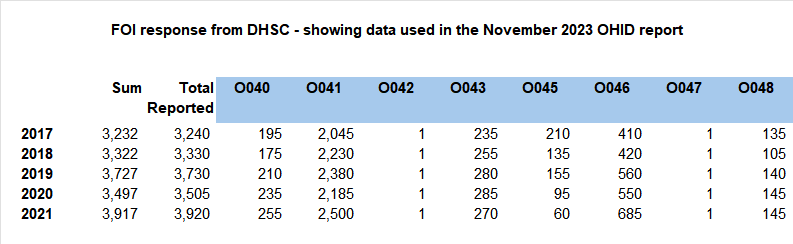
We also made an FOI request to the Department of Health and Social Care asking it to provide the HES data used in the OHID November 2023 comparison report. The data shared in its response are a useful comparison as a check on the FOI responses from the NHS Hospital Trusts.[7]
Results
Abortion complication rates
| Year | OHID rate | FOI rate |
| 2017 | 17.6 | 17.8 |
| 2018 | 17.4 | 17.9 |
| 2019 | 18.9 | 18.6 |
| 2020 | 17.6 | 17.7 |
| 2021 | 19.3 | 18.9 |
| 2022 | 19.4 | |
| 2023 | 20.4 |
This table shows in column two, the rate for complications arising from abortion, including incomplete abortion, published by the OHID in its November 2023 report; the rate is shown per 1,000 abortions.
Column three (righthand side), shows the complications rate from the FOI responses using the same ICD-10 codes as used by OHID.
The five-year average (2017-21) for the OHID rates is 18.2 compared to 18.2 from the FOI responses. The percentage difference between these two over these first five years is just 0.13%, so we can have confidence when publishing the FOI results for 2022 and 2023.
We received responses from 99% of the target FOI requests (120 responses), 88% (106) of which were complete responses used in this analysis. The other 14 responses were either partial, just providing overall ICD-10 group totals, or poorly formatted making it very difficult to accurately transcribe the data into the analysis.
The minor differences between the OHID rates and those from the FOI may be due to the missing or incomplete responses that we have not been able to use, or a timing difference when some hospitals report from e.g., April to March rather than January to December, or the very small differences between the number of distinct patients and admitted patient care spells, or due to the non-disclosure of actual data when the total is less than five cases in any specific period; these are denoted <5 in the FOI responses and counted as 1 in the FOI data analysis.
The Department of Health and Social Care has not yet published the abortion statistics for 2023, and so we need to make an estimate for the annual total number of abortions in England in order to calculate the rate in the bottom righthand cell (FOI 2023). The stated rate, 20.4, is based on an assumption that the total number of abortions in 2023 would be 251,995, an increase of 5% on 2022; this is the average rate of increase over the six years 2017-2022. A higher total number of abortions in 2023 would reduce the FOI reported complications rate; if the abortions total increased by 10.7% year-on-year from 2022 to 2023, the calculated abortion complications rate would remain the same as in 2022, 19.4 complications per 1,000 abortions.
This graph replicates Figure 1 from the OHID report, adding the FOI data for years 2022 and 2023.
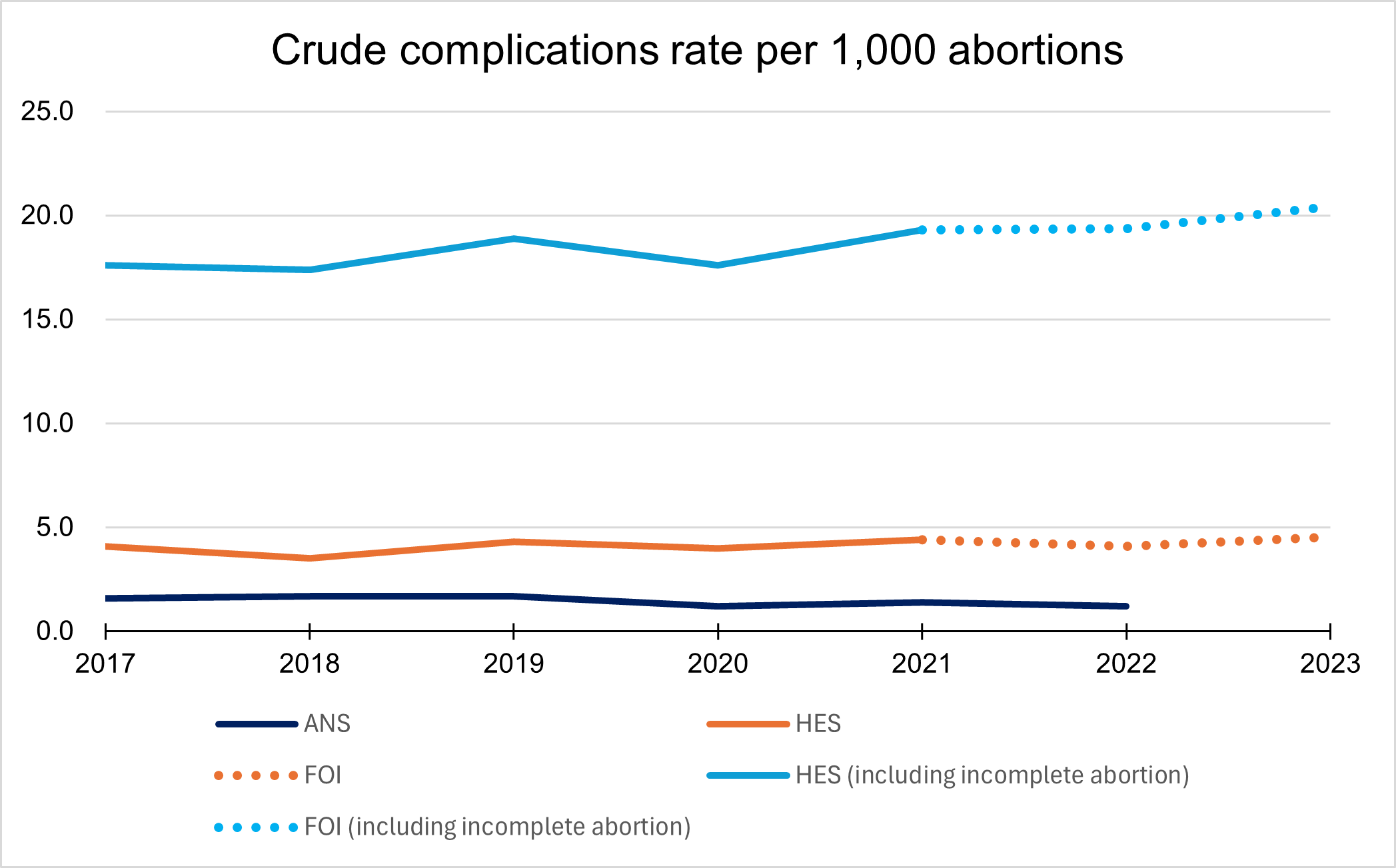
The average rate published by the abortion providers in the Abortion Notification System is 1.5 complications per 1,000 abortions, compared to 18.2 in the Hospital Episode Statistics, a factor of twelve times difference between these two data sources.
Abortion complication totals
The following graph shows these same data as annual reported totals of women treated for abortion complications. This is a stark illustration of the significant underreporting by the abortion providers, as indicated by the ANS data; the annual average reported using ANS is just 304 compared to an average of 3,931 using the HES and FOI data, which include incomplete abortions.

The HES data used in the above for 2017-21 are those used in the OHID report and confirmed from the DHSC response to the FOI request,[8] as shown in the following screenshot from the analysis spreadsheet.[9]
Inclusion of ICD-10 code O044
In its comparison report, the OHID states that it considered but did not use the ICD-10 code ‘O044: medical abortion – incomplete, without complication’. This key issue was raised during the second reading of Lord Moylan’s Private Member’s Bill on 13 December, by Baroness Foster of Aghadrumsee.[10]
We discussed this with a few A&E and OB/GYN professionals, each of whom confirmed that women diagnosed with O044 would have been assessed by ultrasound and found to be suffering from an incomplete abortion and subsequently treated for removal of retained products of conception. Her symptoms at the time of presentation may not have indicated an infection or troublesome bleeding, but the ultrasound confirmed an incomplete abortion, hence the diagnosis ‘incomplete, without complication’. These professionals confirmed that a O044 diagnosis is a complication arising from an incomplete abortion and should be included with the other ICD-10 codes used by OHID, O040-43 and O045-48; the clinical assessment and treatment is the same for each of these nine codes, O040-48.
The FOI request included O044; the total number of cases coded with O044 over the seven years 2017-23, was reported in the FOI responses as 38,464. This compares with a total of 27,577 from all of the codes O040-43 and O045-48; so, there are 1.4 times as many women treated for abortion complications coded as O044, as there are in all of the other codes used in the OHID report.
These data from the OHID report and the FOI responses are shown in the following graph. One way of interpreting these data is to consider that across England in each of the last two years, more than ten thousand women were treated at an NHS hospital for complications arising from an abortion. The official, statutory reporting by the abortion providers (ANS), stated just three hundred women with abortion complications in 2022, about 3% of the total reported by NHS hospitals, 10,409; or put another way, NHS hospitals report treating about 35 times more abortion complications in 2022 than that reported by the abortion providers.
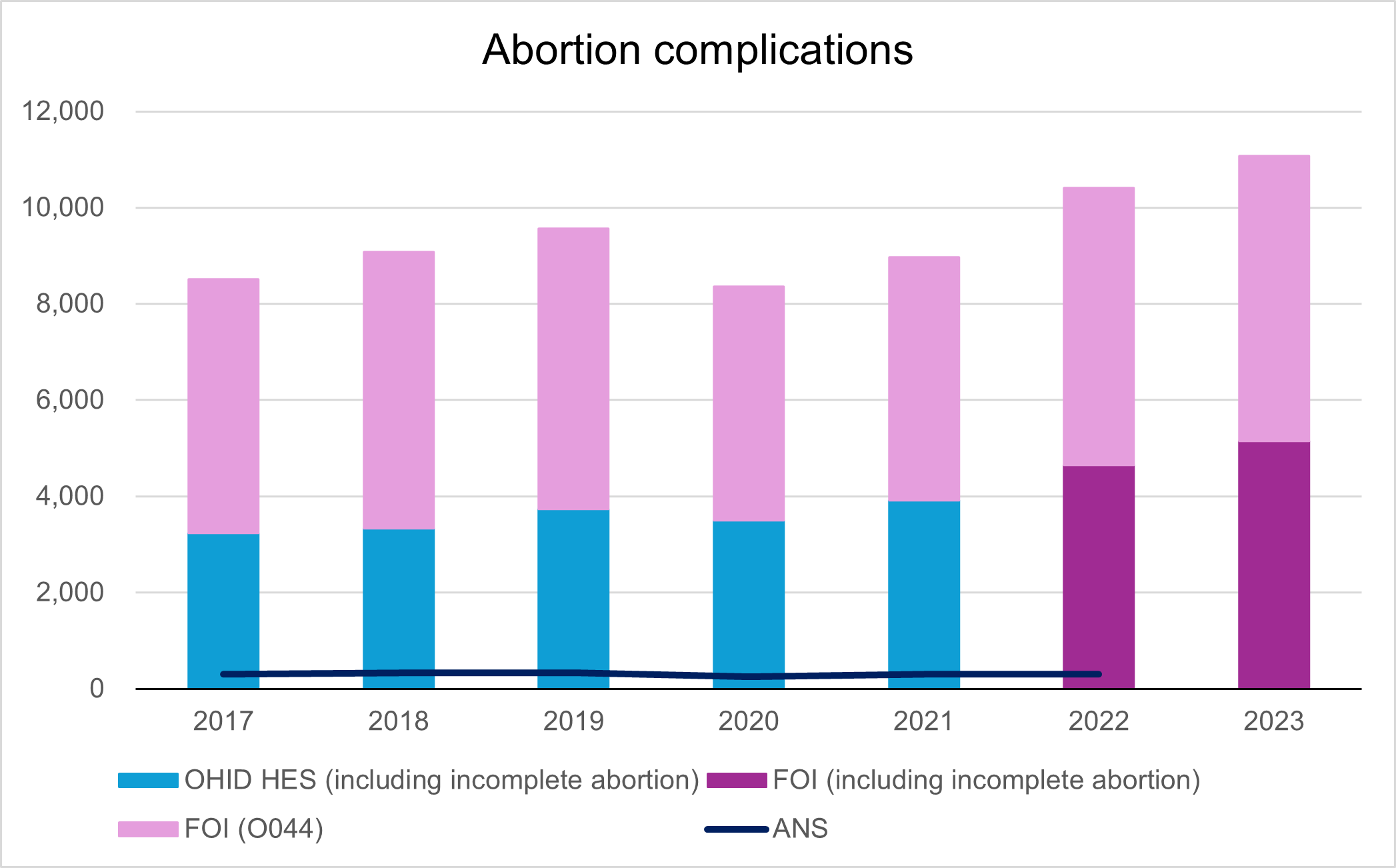
Including O044, the average annual rate of complications being treated at an NHS hospitals is 45.4 per 1,000 abortions, rather than the 1.5 being reported by abortion providers in ANS.
We suggest, for completeness, that future reports should include these O044 cases, and that the risk of a O044 diagnosis and subsequent hospital treatment should be included in the overall discussion of risks when consenting women for an abortion.
Conclusion
Given that the OHID acknowledges that there are significant limitations with the abortion complications data that are collected using the HSA4 form and reported in the Abortion Notification System, and that it has now shown that a more complete and accurate report can be generated using Hospital Episode Statistics as a supplementary source for data, why are we continuing to debate whether or not this should become an official annual publication?
Obviously it would be best if the OHID did so on an annual basis, as proposed in Lord Moylan’s Bill, but if the government chooses not to require the annual reporting of abortion complications using data from Hospital Episode Statistics, it would then be responsible for the deliberate under-reporting of more than ten thousand cases of treatment of abortion complications by our NHS hospitals each year.
The spreadsheet with all of the FOI responses, data and analysis is available upon request from Kevin Duffy.
You can download a PDF version of this report here…
[1] Complications from abortions in England, 2017 to 2021. (2023, November 23). GOV.UK. https://www.gov.uk/government/statistics/complications-from-abortions-in-england-2017-to-2021
[2] Written questions and answers – Written questions, answers and statements – UK Parliament. (2023, December 18). https://questions-statements.parliament.uk/written-questions/detail/2023-12-18/HL1277#
[3] Complications from Abortions (Annual Report) Bill [HL]. (2024, September 03). Parliament.UK. https://bills.parliament.uk/publications/56088/documents/5017
[4] Complications from Abortions (Annual Report) Bill [HL] – Hansard – UK Parliament. (2024, December 13). https://hansard.parliament.uk/Lords/2024-12-13/debates/B4F008C3-FF51-4694-88F6-F60044E3ED58/ComplicationsFromAbortions(AnnualReport)Bill(HL)
also… Complications from Abortions (Annual Report) Bill [HL] – Parliamentary Bills – UK Parliament. (n.d.). https://bills.parliament.uk/bills/3750
[5] Hospital treatments for abortion complications – a batch request. (2024, April 25). WhatDoTheyKnow. https://www.whatdotheyknow.com/info_request_batch/4683
[6] Hospital treatment of abortion complications – a batch request. (2024, April 26). WhatDoTheyKnow. https://www.whatdotheyknow.com/info_request_batch/4688
[7] HES data used in the abortion complications report – a Freedom of Information request to Department of Health and Social Care. (2024, March 26). WhatDoTheyKnow Pro. https://www.whatdotheyknow.com/request/hes_data_used_in_the_abortion_co
[8] Ibid.
[9] The analysis spreadsheet with all data from all 215 responses can be requested from Kevin Duffy.
[10] Complications from Abortions (Annual Report) Bill [HL] – Hansard – UK Parliament. (2024, December 13). https://hansard.parliament.uk/Lords/2024-12-13/debates/B4F008C3-FF51-4694-88F6-F60044E3ED58/ComplicationsFromAbortions(AnnualReport)Bill(HL)#contribution-1CC8C4BF-154D-42C3-B8FD-8A55B198B6A2
