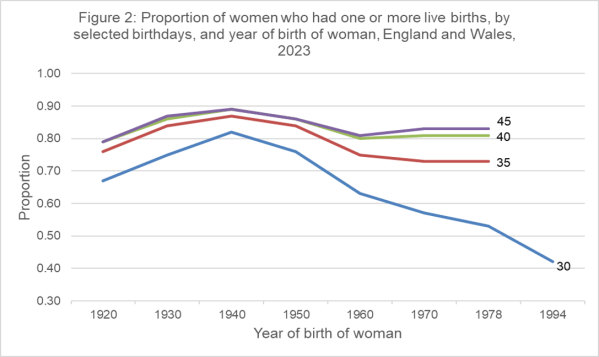
For every three conceptions in UK: one girl, one boy, one abortion. Birth rates have dropped so significantly that our natural population is projected to halve within two generations. Increasingly, young women are delaying motherhood; half remain childless by age 30. Women who are childless at 30 face a 50% chance of remaining childless by... Continue Reading →
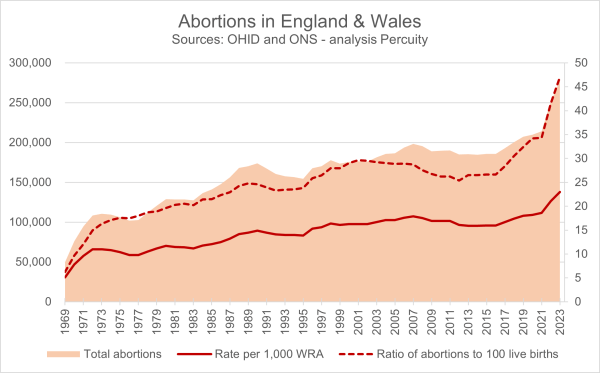
Ratio of abortions to live births
On 17 November 2025, Philip Pilkington, an economist and senior researcher at the Hungarian Institute of International Affairs, posted a thread on X in which he said “Britain is in a phase of self-euthanisation.” [i] He shared some data analysis, including mine,[ii] showing that in 2024 one-third of all viable pregnancies ended in abortion. He... Continue Reading →
Abortion and childlessness
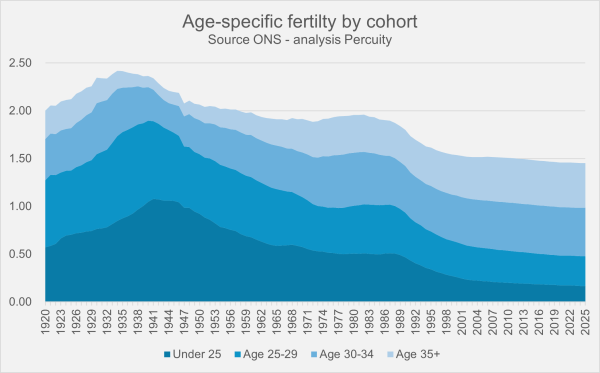
In the next two generations, our natural population is projected to halve, a decline driven largely by increasing childlessness. Current projections suggest that more than 25% of women reaching age 45 in the next 20 years, will do so without having children, and abortion plays a role in about half of these cases. Demographers have... Continue Reading →
The Real Fertility Crisis: wanting, not just affording, children
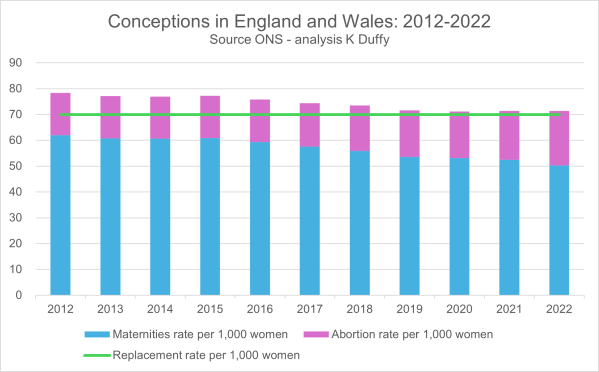
The numbers from the Office for National Statistics could not be clearer: England and Wales are falling short of replacement-level births, with maternities sliding year after year while abortions climb to nearly a third of all conceptions. On paper, the “missing” births are more than accounted for by abortions—but the idea that banning abortion could... Continue Reading →
Are Gen Z aborting half of all pregnancies?
I was recently asked to verify my claim made in an earlier post that “half of all Generation Z pregnancies now end in abortion.” The most recent set of cohort fertility data was published by the Office for National Statistics in July 2025, showing conceptions, maternities, and abortions data for different age-groupings, over the years... Continue Reading →
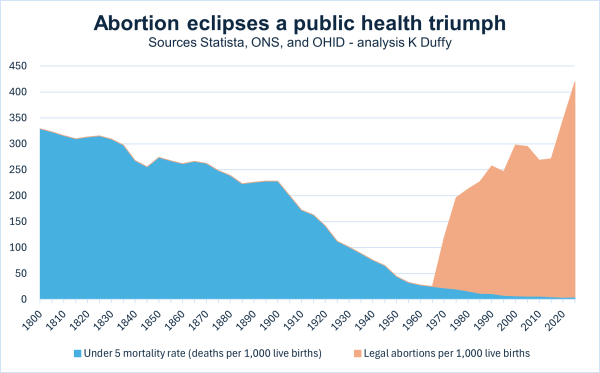
Abortion eclipses a public health triumph
In 1800, roughly one in three children died before their fifth birthday, reflecting an under-five mortality rate (U5MR) of 329 deaths per 1,000 live births. Faced with such high child mortality, women had just under six children on average to ensure that some survived to adulthood—a stark contrast to today’s average of just 1.45. Throughout... Continue Reading →
Kevin Duffy's reply highlights the escalation in UK abortion figures, quoting Baroness Finn's June 6, 2025, House of Lords statement on "the nearly 300,000 women who access abortion services across the UK every year", building on 2022's 251,377 recorded cases. https://twitter.com/KevinDTweets/status/1973663449369682340
54,000 admissions to NHSE hospitals for abortion complications
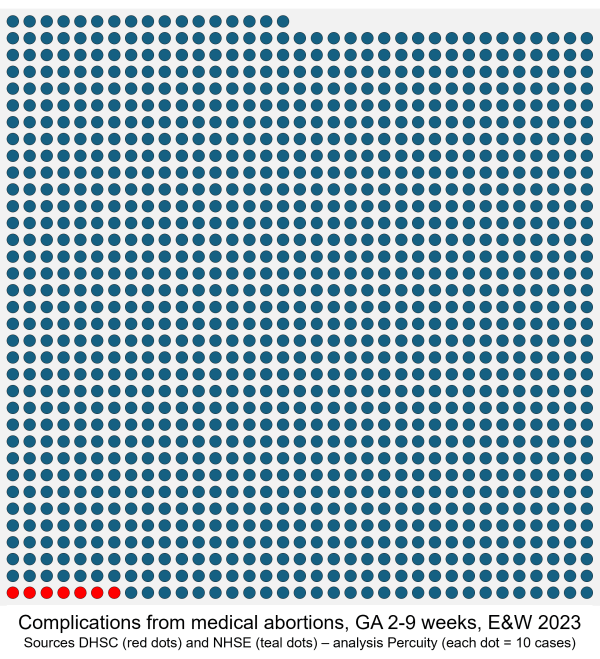
In the five years since the introduction of pills-by-post, more than 54,000 women have been admitted to an NHS hospital in England for the treatment of complications arising from the use of abortion pills. Analysis of accredited official statistics published by NHS England and the Office for Health Improvement & Disparities, shows that 1-in-17 of... Continue Reading →
1,000 women treated each month for abortion complications
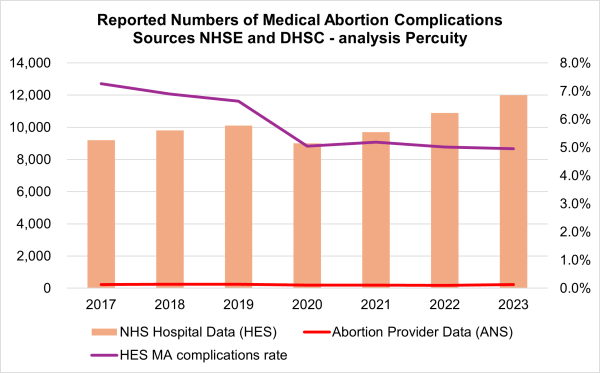
In each of the last two years, more than 12,000 women were admitted to hospital in England for treatment of complications arising from a medical abortion. The Department of Health and Social Care has still not told us how many women had an abortion in 2023, but NHS England has just published its data on... Continue Reading →
Lord Brooke, in the House of Lords, celebrates abortion by asking us to consider how much more our global population might have grown without it, he speaks of abortion as a societal good in controlling population growth. Abortion today is killing one-in-three of our future humanity. In the last 25 years in E&W, we have... Continue Reading →
2023 abortion statistics now 10 months late
A government minister or a higher-up in the Office for Health Improvement & Disparities (OHID) must have decided that timely publication of Abortion Statistics is a waste of time and resource, what other reason is there for a further delay of ten months for this annual report? Parliamentary Questions need to be asked, again. UPDATE... Continue Reading →
Childlessness at 30 is not always unplanned
An increasing proportion of women reaching their 30s, are doing so childless. I agree with demographers and commentators that this is the critical factor in our declining fertility rate but contend that we cannot / should not discuss these falling birth rates without signposting the impact of abortion. In August 2025, the Office for National... Continue Reading →
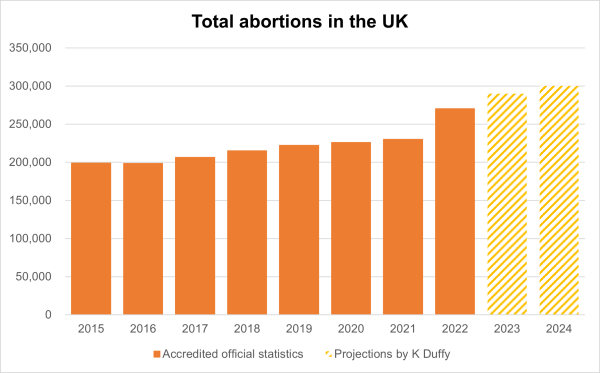
300,000 abortions per year in the UK
In 2024, there were 300,000 abortions in the UK, an 11% increase since 2022, when we last had a full set of accredited official statistics. This is my latest projection based upon recently published data. To be certain this increase is not solely a factor of increasing population, it is important that we also consider... Continue Reading →
11,000 not 300
In 2022, the most recent year for which we have official reporting of abortion statistics for England, more than 11,000 women were admitted and treated at an NHS hospital for complications arising from a medical abortion;[i] this represents about 6% of those women using mifepristone and misoprostol at home, or misoprostol at home after taking... Continue Reading →
Generational impact of abortion as birth control
Is abortion being used as birth control and could it be a critical enabler of our below-replacement birth rates; in just two generations our population will reduce by 40%: 100 adults, 77 children, 59 grandchildren. In 2022, the most recent year in which we have official data for the whole of the UK, there were... Continue Reading →
Live births and abortions – 55 years of data
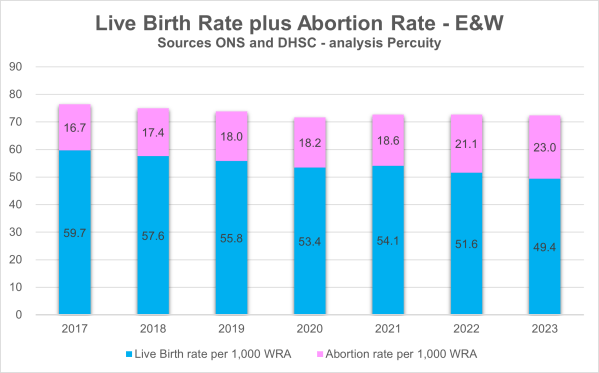
We are missing a critical factor when we discuss the increasing decline in fertility and do not consider or address the impact of abortion. Data from the ONS show us quite clearly that the ‘gap’ between live births and the total needed for replacement has generally been less than the number of abortions. That said,... Continue Reading →
Every day 33 women are treated by NHS England for abortion complications
Official published data from NHS England show that every day, on average, 33 women are admitted as inpatients to an NHS hospital for treatment of abortion complications. This is more than double our earlier estimate of 14, which was based on FOI data.[i] This post: “Government under-reports abortion complications by a factor of 38x”, outlines... Continue Reading →
300,000 abortions in the UK in 2024
There were probably more than 300,000 abortions in the UK in 2024, up from our conservative projection of 292,000 in 2023. This projection is based on official published data in Scotland and Northern Ireland for 2023 and annual reports published by BPAS and MSI-RC for the same year. The last set of official data for... Continue Reading →
Abortion Laws Matter
In Northern Ireland, it has been shown that a law restricting abortion saved more than 100,000 lives in the years from 1967 to 2016. In June 2017, the UK government started to reimburse women who travelled from NI to access abortion services in England and Wales and then in March 2020, the government changed the... Continue Reading →
Government under-reports abortion complications by a factor of 38x
In 2022, official reporting of abortion complications by the Office for Health Improvement and Disparities (OHID) shows just 300 cases across England and Wales. For the year 2022-23, official data from NHS England show 11,256 women diagnosed with abortion complications at an NHS hospital. The NHS data are known to the OHID, as evidenced in its November 2023 report which compares these two data sources, Abortion Notification System (ANS) and Hospital Episode Statistics (HES), and yet government officials refuse to make any change to official annual reporting. The NHS England data are easily accessible by any interested person and the above 11,256 can be retrieved online from NHS Digital in a matter of minutes. No prolonged data compilation, cleaning, and analysis; no need for a Freedom of Information request.