The Royal College of Obstetricians and Gynaecologists has an e-learning module for abortion providers called ‘Making abortion safe’. In the related ‘Medical abortion from 12 weeks of pregnancy: Summary sheet’, it lays out some of the risks that providers need to be aware of for these later-gestation abortions, including a 1-in-7 risk of needing further... Continue Reading →
MORE THAN 10,000 women who took a DIY abortion pill at home provided by the NHS in 2020 ended up needing hospital treatment to deal with the side effects, a new study has revealed. The evidence-based on 85 freedom of information requests to NHS trusts revealed that more than 1 in 17 women, around 20... Continue Reading →
Daily Express
Should DIY abortion be permitted after 10 weeks?
Dame Diana Johnson’s proposed amendment to the Criminal Justice Bill, NC1,[i] seeks to remove women from criminal prosecution if they are found to have self-managed their own abortion. In England and Wales, it is currently legal for a woman to do so through medical abortion until 9-weeks-6-days of pregnancy have elapsed. The equivalent limit is... Continue Reading →
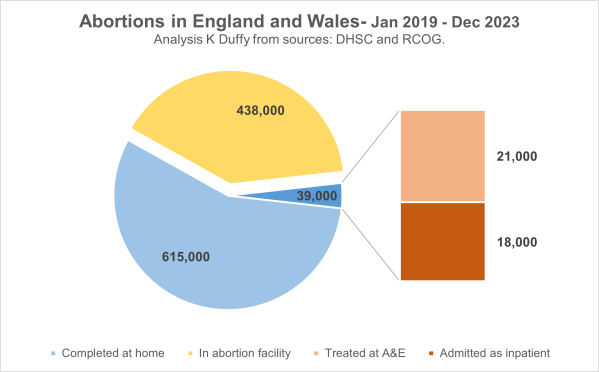
At least 39,000 women treated for DIY abortion complications in five years
In the last five years across England and Wales, at least 39,000 women have been treated at NHS hospitals for complications arising from failed or incomplete DIY medical abortions at home; in the past, these complications would have been treated at the abortion providers’ facilities. Five years ago, abortion was only provided at approved abortion... Continue Reading →
Abortion Complications – new official statistics
On 23 November 2023, the Office for Health Improvement & Disparities (OHID), part of the Department of Health and Social Care (DHSC), published new official statistics reporting the rate of complications arising from abortions in England. Previous reporting from the DHSC relied solely on data gathered from the HSA4 forms that are routinely submitted by... Continue Reading →
Government has no plans to report on all abortion complications
The Government recently published new statistics showing that many thousands of women are being treated for abortion complications at NHS hospitals. In its report, the Department noted that these complications were not being reported by the independent abortion providers such as BPAS and MSI Reproductive Choices, and yet there are no plans to make this... Continue Reading →
Do early medical abortions fail 6% of the time?
Yes. The RCOG states that in up to 1% of all cases pregnancy continues after the woman has taken the abortion pills and that in up 6% of all cases the abortion is incomplete; another procedure is required to correct both types of treatment failure. That said, some only consider ‘failure’ to include the first... Continue Reading →
3,900 hospital admissions in 2021 for abortion complications
In England during 2021, at least 3,900 women were admitted to an NHS hospital for surgical treatment of complications arising from abortion. On 23 November 2023, the Office for Health Improvement & Disparities (OHID), part of the Department of Health and Social Care (DHSC), published new official statistics reporting the rate of complications arising from... Continue Reading →
Abortion complications massively under-reported
Abortion providers are massively under-reporting the incidence of complications arising from incomplete medical abortions. They also under-state the risk of an incomplete abortion when consenting women for this procedure. Thankfully, Lord Jackson has questioned the Government about this critical issue and is holding the Department for Health and Social Care (DHSC) to account to ensure... Continue Reading →
At-home abortions are putting women’s health at risk.
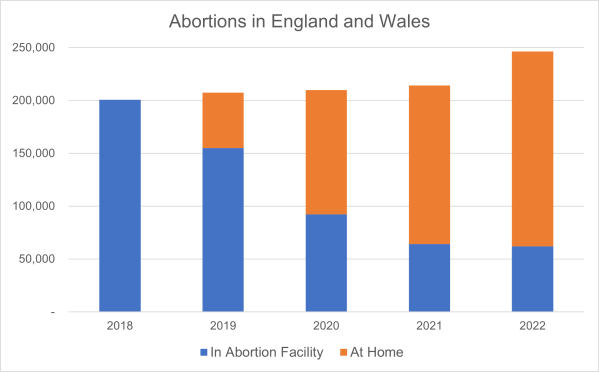
This post was first published by Christian Today on 14 July 2023. Across England and Wales, three in every four abortions - or 75% - are now performed by women at home using abortion pills. The Department of Health and Social Care (DHSC) recently reported a 17% increase in the number of abortions: a total of 123,219... Continue Reading →
Redefining DIY abortion effectiveness to include a failure rate of 10%.
Abortion activists in the US are rushing to promote a new study that claims DIY medication abortion at home is safe and effective after 9 weeks gestational age, minimising or even ignoring the observed 10% failure rate and the recognised harm to women. The study by Moseson et al. was published in Obstetrics & Gynecology... Continue Reading →
This is ideology not evidence.
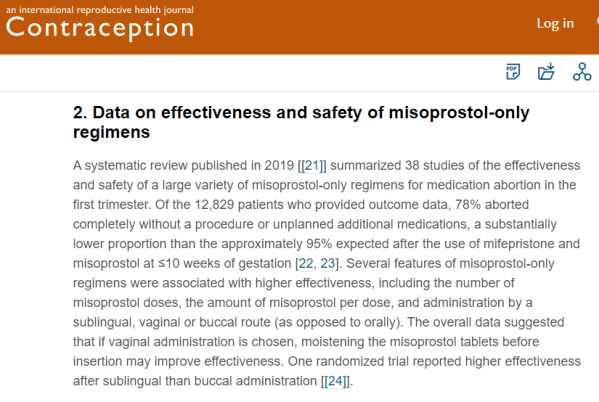
“…misoprostol, can be safely and effectively used on its own.” That’s what MSI Reproductive Choices is telling the public about a medical abortion treatment known to fail once in every five cases. This statement follows a similar one by Dr Grossman, a leading abortion researcher and advocate in the U.S., “What do people need to... Continue Reading →
The Abortion Pill is not always effective.
Medical Abortion (MA), aka the abortion pill, doesn’t always work; it is well-established that MA has an expected and commonly occurring treatment failure rate of about 5%. Meaning that as many as 1-in-20 pregnant women using abortion pills will subsequently need additional medical treatment for complications arising from an incomplete abortion. Medical abortion treatment failure... Continue Reading →
25,000 Reasons Why 95% is Not Good Enough.
New York Times review Research shows that the abortion pill fails in 5% of cases – that’s the findings from a New York Times review of 101 studies covering 124,000 first trimester abortions performed in 26 countries over the last 30 years. Non-negligible risk of failure. It is well-known that medical abortion will sometimes fail,... Continue Reading →
Are Abortion Pills Safe? Here’s the Evidence.
It's not just about ‘safety’ – the abortion pill (mifepristone and misoprostol) is medically safe for the woman; serious complications from medical abortion including hospitalisation, blood transfusion, major surgery, or death are rare. Arguing for changes to the legal and regulatory control of medical abortion solely based on safety is a very weak argument. Now... Continue Reading →
"In the product literature the frequency of side-effects is generally described as above." This is from the British National Formulary at NICE.
Emergency Ambulance Responses Three Times Higher for Pills-by-Post.
Data obtained from five NHS Ambulance Trusts in England, show that emergency ambulance responses for complications arising after a medical abortion are three times higher for women using pills-by-post at home, compared to those who have their medical abortion in a clinic. Using our rights under the Freedom of Information Act, we asked each of... Continue Reading →
Less Than 1-in-5 Complications are Reported.
Did you know that the Government and Abortion Providers routinely under report the rate of complications caused by abortion pills? Our freedom of information investigation reveals that less than 1-in-5 complications are being reported. DHSC Under Report. The official DHSC statistics for 2020 show a 1.1% complication rate for all medical abortions and only 0.3%... Continue Reading →
Medical Abortion Fails 1-in-17 Women.
Medical abortion doesn't always work; it is well established that MA has an expected treatment failure rate of about 6%. Which means that as many as 1-in-17 pregnant women using abortion pills will subsequently need hospital treatment for complications arising from an incomplete abortion. Ranbaxy (UK) Limited is the manufacturer of Medabon, the mifepristone/misoprostol combination... Continue Reading →
Six Percent Require Emergency Care.
Gynuity Health Projects, a pro-abortion activist organisation, recently published results from its own study into the safety and efficacy of telemedicine abortion. Two key findings are: Six percent of women using abortion pills at home, subsequently needed hospital treatment because of complications related to the abortion, a rate of 1-in-17. Four percent of women using... Continue Reading →