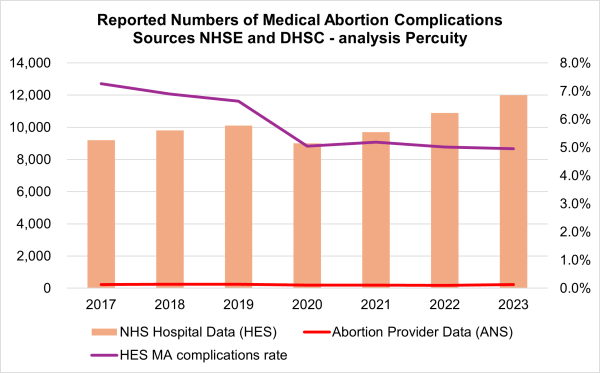
It is not possible on the telephone to ensure a woman’s privacy, to ensure that she is not being coerced. Government stats show that, since 2020, 54,000 people have been admitted to hospital in England for complications from abortion pills. Last year alone, some 12,000—over 6% of women taking such medication—required hospital treatment. To safeguard... Continue Reading →
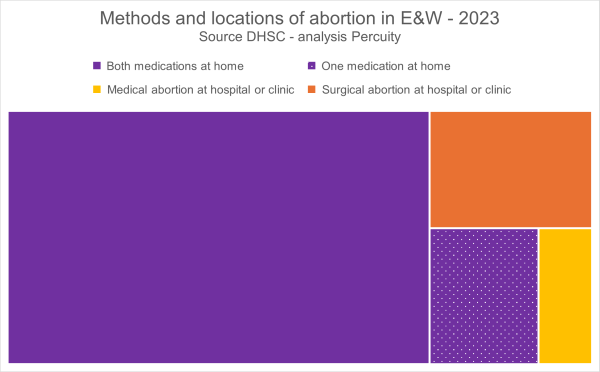
Research organisation Percuity reported that, according to the NHS data, 1-in-17 women who had an abortion at home required hospital care for complications including incomplete abortions, infections, and excessive haemorrhages.
The Christian Institute
“The government is fully aware of the numbers of women being admitted to hospital for treatment of abortion complications but for some reason seems unwilling to report these on an annual basis,” Duffy wrote. He called for greater transparency and accountability, arguing, “Deliberately minimising and misleading women about the reality of these risks is no... Continue Reading →
Grand Pinnacle Tribune
Duffy's NHS England analysis of hospitalizations for treatment of abortion complications, a rate of 1-in-17, reflects concerns raised by many in the United States regarding an increase in women visiting emergency departments after REMS safety regulations were weakened by the Food and Drug Administration (FDA) under the Biden-Harris administration. Biden's FDA also removed in-person dispensing... Continue Reading →
Live Action
54,000 Hospitalized in UK After Injuries From Abortion Pills... Campaigners argue that women cannot give informed consent if the risks are downplayed, and that deliberately minimising these dangers is unacceptable.
Life News
54,000 admissions to NHSE hospitals for abortion complications
In the five years since the introduction of pills-by-post, more than 54,000 women have been admitted to an NHS hospital in England for the treatment of complications arising from the use of abortion pills. Analysis of accredited official statistics published by NHS England and the Office for Health Improvement & Disparities, shows that 1-in-17 of... Continue Reading →
Growing concerns over abortion pill safety on both sides of the Atlantic... Kevin Duffy has raised alarm over the findings that recent NHS figures reveal around 1,000 women each month require emergency care after experiencing issues linked to medical abortions.
Christian Today
1,000 women treated each month for abortion complications
In each of the last two years, more than 12,000 women were admitted to hospital in England for treatment of complications arising from a medical abortion. The Department of Health and Social Care has still not told us how many women had an abortion in 2023, but NHS England has just published its data on... Continue Reading →
Every day 33 women are treated by NHS England for abortion complications
Official published data from NHS England show that every day, on average, 33 women are admitted as inpatients to an NHS hospital for treatment of abortion complications. This is more than double our earlier estimate of 14, which was based on FOI data.[i] This post: “Government under-reports abortion complications by a factor of 38x”, outlines... Continue Reading →
Saying “Sorry”
Providers of regulated healthcare are obliged by law to say “Sorry” to patients when something goes wrong. The Care Quality Commission (CQC) details this in its Regulation 20: Duty of Candour. This post examines whether it is possible that BPAS failed to meet this statutory requirement in at least 5,000 cases during the last year.... Continue Reading →
Government under-reports abortion complications by a factor of 38x
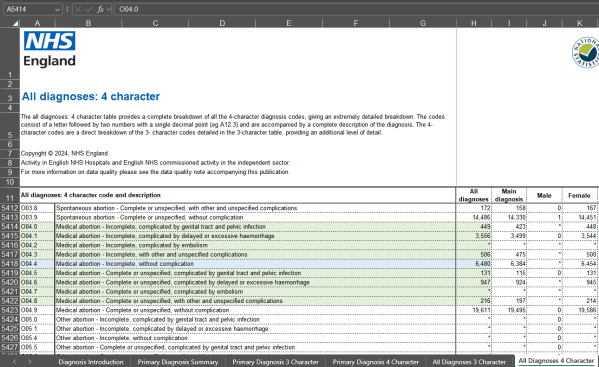
In 2022, official reporting of abortion complications by the Office for Health Improvement and Disparities (OHID) shows just 300 cases across England and Wales. For the year 2022-23, official data from NHS England show 11,256 women diagnosed with abortion complications at an NHS hospital. The NHS data are known to the OHID, as evidenced in its November 2023 report which compares these two data sources, Abortion Notification System (ANS) and Hospital Episode Statistics (HES), and yet government officials refuse to make any change to official annual reporting. The NHS England data are easily accessible by any interested person and the above 11,256 can be retrieved online from NHS Digital in a matter of minutes. No prolonged data compilation, cleaning, and analysis; no need for a Freedom of Information request.
FOI requesting HES data on the treatment of abortion complications in England, 2017 to 2023.
We have published a new report outlining findings from an FOI investigation in which we requested data related to the diagnosis of abortion complications, from all NHS Hospital Trusts in England. Key Points The Office for Health Improvement & Disparities (part of the Department of Health and Social Care) published a one-off report in November... Continue Reading →
Complications reporting is complicated and incomplete
An effective medical abortion is defined by the MARE Guidelines[i] as a successful expulsion of an intrauterine pregnancy without the need for surgical intervention, clarified by the following sub-categories: Continuing pregnancy: treated with surgical management Continuing pregnancy: patient opted to continue or outcome is unknown Retained products treated with surgical management (an evacuation of retained... Continue Reading →
Abortion Complications – new official statistics
On 23 November 2023, the Office for Health Improvement & Disparities (OHID), part of the Department of Health and Social Care (DHSC), published new official statistics reporting the rate of complications arising from abortions in England. Previous reporting from the DHSC relied solely on data gathered from the HSA4 forms that are routinely submitted by... Continue Reading →
Government has no plans to report on all abortion complications
The Government recently published new statistics showing that many thousands of women are being treated for abortion complications at NHS hospitals. In its report, the Department noted that these complications were not being reported by the independent abortion providers such as BPAS and MSI Reproductive Choices, and yet there are no plans to make this... Continue Reading →
3,900 hospital admissions in 2021 for abortion complications
In England during 2021, at least 3,900 women were admitted to an NHS hospital for surgical treatment of complications arising from abortion. On 23 November 2023, the Office for Health Improvement & Disparities (OHID), part of the Department of Health and Social Care (DHSC), published new official statistics reporting the rate of complications arising from... Continue Reading →
Abortion complications massively under-reported
Abortion providers are massively under-reporting the incidence of complications arising from incomplete medical abortions. They also under-state the risk of an incomplete abortion when consenting women for this procedure. Thankfully, Lord Jackson has questioned the Government about this critical issue and is holding the Department for Health and Social Care (DHSC) to account to ensure... Continue Reading →
Medical Abortion has a 5% failure rate.
Marie Stopes Australia (MSA) says that more than 5% of the medical abortions it provides, fail to complete. Meaning that 1-in-20 women will have fragments of the baby and/or placenta remaining in their womb after taking both sets of the tablets, mifepristone and misoprostol. These women will need to seek further treatment to prevent ongoing... Continue Reading →
Listen to the all of the data, not just some of it.
The Royal College of Obstetricians and Gynaecologists (RCOG) is promoting a new cohort study into the safety, efficacy, and acceptability of telemedicine early medical abortion by Aiken et al. published in BJOG here. RCOG lauds this as the largest data study into telemedicine abortion, whilst the authors caution that there are gaps and possible inconsistencies... Continue Reading →
Freedom of Information investigation into complications from abortion at home.
In this briefing we bring you three new sets of data about early medical abortion services being provided across England and Wales. Our analysis will help to inform those responding to government consultations, which ask for your views on whether or not the temporary measure introduced during the COVID-19 pandemic, allowing women and girls to... Continue Reading →