In its SmPC (summaries of product characteristics), Ranbaxy states that there is a non-negligible risk of medical abortion treatment failure, as follows: The non-negligible risk of failure, which occurs in 4.5 to 7.8% of the cases, makes the follow-up visit mandatory in order to check that abortion is complete. The patient should be informed that... Continue Reading →
What do new abortion figures from Scotland reveal?
On 25 May 2021, Public Health Scotland (PHS) released its official abortion statistics for the year ending December 2020. You may have already read that in 2020 there were a total of 13,815 abortions, the highest annual total since 2008, and that 36% of these were repeat abortions, which continues an increasing trend year-on-year. In this short... Continue Reading →
How ‘DIY’ home abortion is placing women at risk.
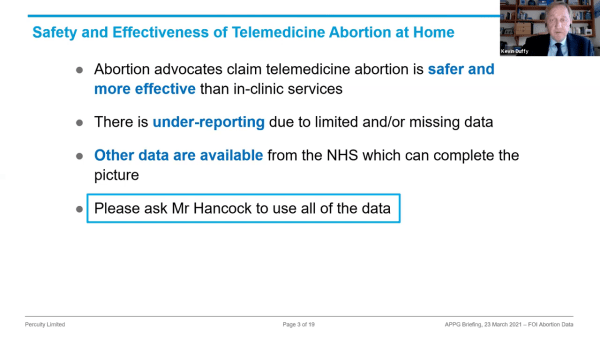
On 23 March 2021, I presented at an online briefing hosted by the All-Party Parliamentary Pro-Life Group for MPs from across the UK, along with politicians from the Scottish Parliament and Welsh Senedd. This was an opportunity to share some of the findings from our recent freedom of information investigation. Led by Co-Chair of the... Continue Reading →
Posting is not the same as dispensing.
If you are going to use reduced waiting times to substantiate your preference for telemedicine abortion, then you need to make sure that you are comparing like-for-like. It is wrong to compare the elapsed time from first contact to in-clinic dispensing, with the time from first contact to posting the abortion pills; posting is not... Continue Reading →
Abortion Provider saddened and angered by term ‘DIY abortion’.
Caroline Gazet, UK Clinical Director for MSI Reproductive Choices, says that she is both saddened and angered by the term ‘DIY abortion’. This made me smile. It is ironic for a senior member of the Marie Stopes team to complain about others using such terminology to describe abortion at-home when they themselves are fixated on... Continue Reading →
Parliamentary Briefing: evidence from FOI investigation.
On 04 March 2021, I was invited by Christian Concern to give a briefing to a cross-party group of politicians. This was an opportunity to share some of the findings from our recent freedom of information investigation. You can download my slides and watch the briefing here; there is also a link to the full... Continue Reading →
Alone, but not alone.
Pills-by-post has brought notable change for vulnerable women living with an abusive partner at home. The approval for telemedicine abortion, in which the woman does not need to first visit a clinic, has made it much easier for an abusive partner to coerce a vulnerable woman into having an abortion in the privacy of her... Continue Reading →
Listen to the all of the data, not just some of it.
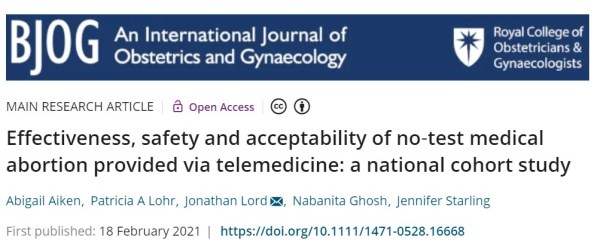
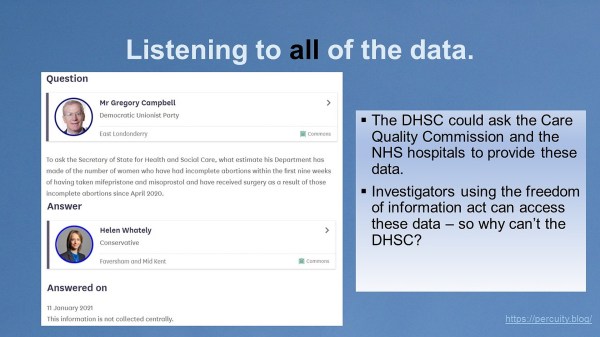
The Royal College of Obstetricians and Gynaecologists (RCOG) is promoting a new cohort study into the safety, efficacy, and acceptability of telemedicine early medical abortion by Aiken et al. published in BJOG here. RCOG lauds this as the largest data study into telemedicine abortion, whilst the authors caution that there are gaps and possible inconsistencies... Continue Reading →
Freedom of Information investigation into complications from abortion at home.
In this briefing we bring you three new sets of data about early medical abortion services being provided across England and Wales. Our analysis will help to inform those responding to government consultations, which ask for your views on whether or not the temporary measure introduced during the COVID-19 pandemic, allowing women and girls to... Continue Reading →
Is the rate of abortion complications falling?
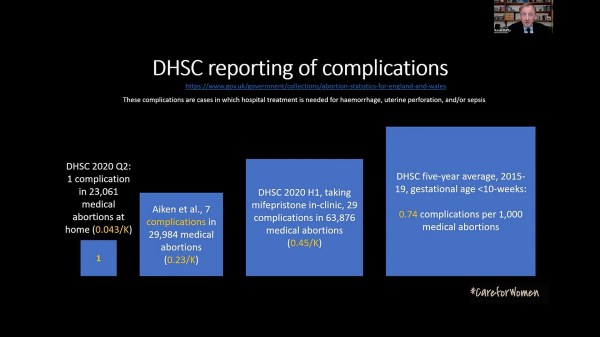
Official government data shows that each year, over 300 women suffer complications from abortion. Statistics from the Department of Health and Social Care for the last five years, shows that each year, 313 women who have an abortion in England and Wales, suffer from complications requiring hospital treatment, including haemorrhage, sepsis, and uterine perforations. This... Continue Reading →
RSOP12: Information for Women.
In the UK, providers of abortion services must comply with the Required Standard Operating Procedures (“the RSOPs”) set out in this document issued by the Department of Health and Social Care. RSOP12 details the information which must be provided to the woman, and how: Women must be given impartial, accurate and evidence-based information (verbal and written)... Continue Reading →
How the pandemic revolutionised abortion access in the UK.
This is my response to an article in the New Statesman on December 15th, 2020. My main concern is the assertion that abortion has become safer since the introduction of telemedicine in April. The article states that there has been just one complication in more than 23,000 abortions at home, and that is clearly wrong,... Continue Reading →
Less than half choose pills by post.
Since government approval was granted for telemedicine abortion at home, less than half of all eligible women have chosen, or were offered, the option of pills by post. There are more women still visiting abortion clinics than those using telemedicine. On March 30th, 2020, in response to the COVID-19 lockdown and the ensuing difficulties facing... Continue Reading →
Care for Women: Parliamentary Briefing.
In this ten-minute video clip, I outline the findings from our Mystery Client Investigation into the provision of telemedicine abortion at home. https://videopress.com/v/h87QuJaU?resizeToParent=true&cover=true&preloadContent=metadata This was at a briefing for parliamentarians organised and hosted by Christian Concern on Thursday 10th December. Other speakers included: The lawfulness of pills-by-post (Roger Kiska, Legal Counsel, Christian Legal Centre) New... Continue Reading →
What is early medical abortion at home?
Abortion supporters go to great lengths to assure women that at early gestations, their ‘pregnancy’ is nothing more than a clump of cells, that it is not yet a baby. This article shows how a baby develops in utero, from the moment of conception. On 30 March 2020, Matt Hancock, the Secretary of State for... Continue Reading →
2,800 failed abortions at-home.
Based on official data, it's likely that there have been 2,800 failed, incomplete abortions self-administered by women at home since the start of April; 350 incomplete every month. Official government data issued by the Department of Health and Social Care show that during April-June there was a monthly average of 17,800 abortions across England and... Continue Reading →
Campaigning for women to attend abortion clinics.
I was recently asked: “…do we really want women to spend more time in the care of abortion providers? Why would we campaign for that?” This was asked in the context of the public consultation into the ‘Future Arrangements For Early Medical Abortion at Home’, currently being conducted in Scotland. My answer is unequivocal: “Yes,... Continue Reading →
Care at home – the reality behind the hashtag.
#CareAtHome is being used by many on Twitter lobbying for the provision of telemedicine abortion in Northern Ireland. #CareAtHome – sounds so nice, who wouldn’t want it, but what’s the reality behind the hashtag? I suppose #CareInMyBathroom or #CareOnMyToilet doesn’t have the same appeal. Realities of abortion at home. On 28 May, the Daily Mail published a... Continue Reading →