Doctors are legally obliged to have enough evidence to justify forming a good faith opinion that a woman’s pregnancy is below the 10-weeks limit before prescribing pills-by-post and enabling her abortion at home. The DHSC does not consider this to be possible in the absence of an in-person consultation.
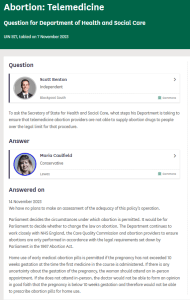
On 07 November 2023, Scott Benton MP asked the Secretary of Health and Social Care: “what steps his Department is taking to ensure that telemedicine abortion providers are not able to supply abortion drugs to people over the legal limit for that procedure.”
Maria Caulfield, Parliamentary Under-Secretary (Department of Health and Social Care), responded on 14 November saying:
Home use of early medical abortion pills is permitted if the pregnancy has not exceeded 10 weeks gestation at the time the first medicine in the course is administered. If there is any uncertainty about the gestation of the pregnancy, the woman should attend an in-person appointment. If she does not attend in-person, the doctor would not be able to form an opinion in good faith that the pregnancy is below 10 weeks gestation and therefore would not be able to prescribe abortion pills for home use.
Let’s explore this issue of ‘good faith’ opinion.
Prior to March 2020, a woman could only have an abortion after first attending an in-person clinical consultation at the abortion facility. During that visit, she would rarely have met with the doctor who was going to certify her abortion and prescribe the pills for her early medical abortion. Instead, she would have met with members of the multidisciplinary team (MDT) working for the doctor, who is referred to in the regulations as the registered medical practitioner (RMP); in practice, she met with and was assessed by a nurse or a midwife who was under the supervision of the RMP. Referring to the clinical notes from the MDT, the doctor would be able to, in good faith, be sure of the gestational age, because that had been clinically assessed by their own trained and supervised team members.
Abortion by phone and pills-by-post, enacted at the end of March 2020 as an emergency measure during Covid-19, put an end to that clinical diligence. Now, when trying to form a good faith opinion, the doctor is solely relying on the woman’s accurate and honest disclosure and her own self-assessment of the gestational age of her pregnancy.
That is simply not good enough, and certainly does not provide the degree of certainty required to pass any reasonable test of good faith.
Caufield, on behalf of the DHSC, raises a critical concern that in the absence of an in-person consultation, an abortion doctor will not be able to form a good faith opinion that the woman’s pregnancy is below the legal limit of 10 weeks gestation and therefore should NOT prescribe the abortion pills for use by the woman at home.
The tone of this official parliamentary response should set the alarm bells ringing for any doctor who is certifying an abortion for a woman who they themselves have not met or spoken to and who has not been seen in-person by members of their clinical team.
In its guidance for doctors who are certifying an abortion, the DHSC says:
Notes for certifying registered medical practitioners.
Certifying registered medical practitioners are expected to have enough evidence to justify that they were able to form a good faith opinion that, if the medicine prescribed for the termination of the pregnancy is administered in accordance with their instructions, the pregnancy will not exceed 10 weeks at the time when the first early medical abortion pill is taken.
If there is evidence that a certifying registered medical practitioner has not formed an opinion in good faith, then those performing the termination are not protected by the act and may have potentially committed a criminal offence by terminating the pregnancy.
Failure to meet the certification requirements may be a breach of the Abortion Regulations.
This is clear, unless a doctor has “enough evidence” to be certain of the gestational age, then they could be found to have committed a criminal offence. I wonder if the DHSC considers what a woman tells her abortion nurse on the phone to be enough evidence.
How do the two BPAS doctors who certified the abortion for Carla Foster feel when considering the above. Are they sure that they can present enough evidence to justify their decision to prescribe abortion at home for her?
Discover more from Percuity
Subscribe to get the latest posts sent to your email.
