When talking about their ideology of abortion decriminalisation, activists will often emphasise that this will not mean abortion would be freed from all regulations. In this post we start to explore which regulations they might be referring to and whether these are currently being complied with.
In tabling her proposed amendment to the Criminal Justice Bill (CJB) Dame Diana Johnson said: “In the 21st Century, abortion should be most effectively regulated as a healthcare matter.”
In the ‘Reforming Abortion Law’ position paper, the Royal College of Obstetricians and Gynaecologists (RCOG) states on behalf of a coalition of 33 abortion-supporting organisations: “We believe that abortion is healthcare that should be treated and regulated like any other medical procedure…”
RSOPs
The Department of Health and Social Care (DHSC) has published a set of 21 required standard operating procedures (RSOPs) that all independent abortion providers must comply with. The first of these requires the abortion provider to ensure choice of abortion procedure method:
“a choice of method should be offered where clinically appropriate.…For all gestations, women must be given a choice of surgical and medical terminations up to the legal limit as part of a care pathway.”
Patient care – RSOP 1: access to timely abortion services
Methods being provided
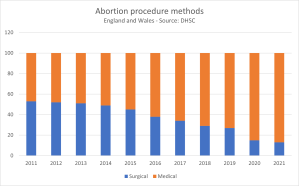
In 2011, 53% of all abortions in England and Wales were provided using surgical methods and 47% medical. Over the following ten years this balance shifted significantly towards medical, 87%.[i]
Data is only available for the first six months of 2022, showing for that period 96% of all early abortions, those under 10-weeks gestation, were provided using the medical method.[ii]
In June 2020, the British Society of Abortion Care Providers (BSACP) published a position paper ‘Providing Genuine Choice’, in which it raised concerns about the, then, high rates of medical abortion, saying: “With these high proportions of procedures done medically, the question arises as to how many of these procedures were individually chosen and how many done with no real choice on offer.”
There are two points of interest about the above statement:
- The imbalance towards medical abortion has continued to increase, the latest official data shows 96% in the first six months of 2022
- Jonathan Lord, Medical Director at MSI-RC, is the Co-Chair at BSACP and he is supported in this role by a number of senior managers from BPAS – it is they who are raising the concern about a provider bias towards medical abortion and the real lack of choice offered to women.
The society acknowledges that an abortion provider might not always be able to offer all methods but states clearly that providers must always discuss all method options with women, even those that they are not able to provide, and refer as necessary, saying: “Choices about the method of abortion should include all options, including those needing referral.”
BPAS and MSI-RC failing to comply?


It is worth noting that neither BPAS nor MSI-RC are currently providing medical abortion at gestations above 10-weeks.
Based on the very high proportion of medical abortion procedures for gestations under 10-weeks and only surgical methods on offer over 10w, perhaps it is fair to suggest that the independent abortion providers, BPAS and MSI Reproductive Choices, are not currently complying with the first of these 21 RSOPs.
[i] Tab T3a of ‘Abortion statistics 2021: data tables (revision)’ accessed from https://www.gov.uk/government/statistics/abortion-statistics-for-england-and-wales-2021 on 08 December 2023.
[ii] Tab T1 of ‘Abortion statistics January to June 2022: data tables’ accessed from https://www.gov.uk/government/statistics/abortion-statistics-for-england-and-wales-january-to-june-2022 on 08 December 2023.
Discover more from Percuity
Subscribe to get the latest posts sent to your email.
