In early 2020, the Royal College of Obstetricians and Gynaecologists issued guidance to support a no-test protocol that was a prerequisite to the government’s approval for telemedicine abortion and pills-by-post. A critical element of this was its advice “that routine pre-abortion ultrasound scanning is unnecessary.” [1]
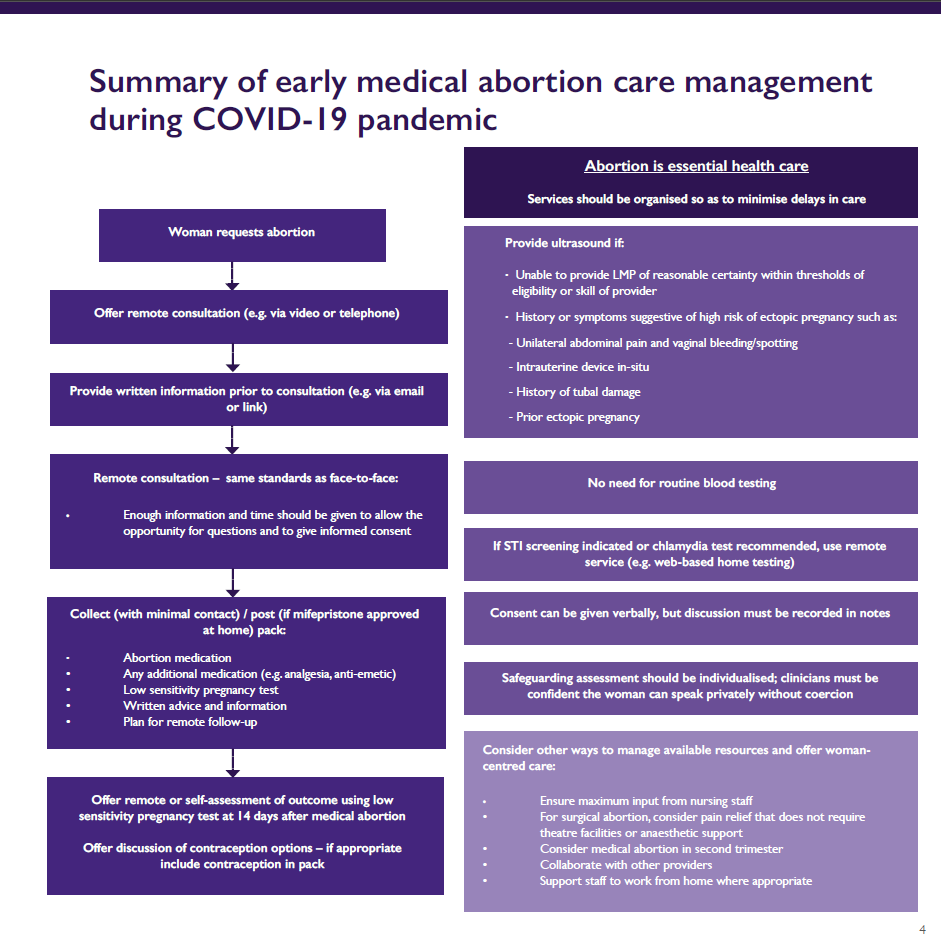
In its published guidance, at section 2.1.1: ‘Gestation assessment’, RCOG cites evidence indicating that only 1.2% of women are mistaken when self-assessing the gestational age of their pregnancy by recall of the date of the first day of their last menstrual period (LMP). The advice was, that given this very high level of accuracy, 98.8%, it is not necessary for women to have an in-clinic assessment, that the full consultation could be completed remotely by phone, and the prescribed abortion pills sent to the women by post, for self-administration at home.[2]
BPAS recently published the findings of its internal review of various modalities of screening assessments for no-test-medical abortion. It was trying to determine the difference when remote screening, for whether a pre-abortion ultrasound scan was necessary, was conducted by clinical staff (midwives and nurses), or by call-centre agents, or by the woman herself using an online questionnaire. The results from this review were presented at the 17th Congress of the European Society of Contraception and Reproductive Health, held in Spain in May 2024.[3]
On page 88-89 of the ESC Abstract Book 2024, BPAS states that over three periods, starting in May 2021 – ending August 2023, it provided 145,682 abortions to women who were under 10-weeks gestational age. The critical finding is that 63,845 women were assessed as requiring an ultrasound prior to their abortion treatment. This indicates there was sufficient doubt about relying solely on assessment by LMP, that an ultrasound was required in 43% of all cases.[4]
There is a very significant, very large, difference between the previously stated 1.2% by RCOG and this real-world, in practice 43%.
This begs the question, that if 43% of women need to have an ultrasound before their abortion consultation, then why are we continuing with this broken telemedicine abortion model?
[1] Coronavirus (COVID-19) infection and abortion care (n.d.). RCOG. https://www.rcog.org.uk/guidance/coronavirus-covid-19-pregnancy-and-women-s-health/coronavirus-covid-19-infection-and-abortion-care/
[2] Information for healthcare professionals. (2020). Coronavirus (COVID-19) infection and abortion care. https://www.rcog.org.uk/media/bbhpl2qa/2020-07-31-coronavirus-covid-19-infection-and-abortion-care.pdf
[3] 17th ESC Congress – ESCRH. (2024, May 3). ESCRH. https://escrh.eu/event/17th-esc-congress-3/
[4] ESC Abstract Book 2024. https://escrh.eu/wp-content/uploads/2023/05/abstract-book-v5.pdf
Discover more from Percuity
Subscribe to get the latest posts sent to your email.
