In its recently published report into abortion statistics for 2022 (England and Wales), the UK Government presented misleading and incomplete data about the numbers of complications arising from medical abortions; and worse still, they knew they were doing so.[i]
In fairness to the reporting team at the Office for Health Improvement & Disparities, they do say:
“Data on complications should be treated with caution. It is not possible to fully verify complications recorded on HSA4 forms and complications that occur after discharge may not always be recorded. This means that, for medical terminations where either both or the second stage was administered at home, complications may be less likely to be recorded on the HSA4.”
Whilst noting this widely acknowledged gap in reported complications when using the Abortion Notification System (ANS relies on the HSA4 forms), they signpost an alternative data report that they themselves published in November 2023, using the Hospital Episode Statistics [ii] and also the stated complications rate on the official NHS website [iii], but for some unknown reason they decided not to report the alternative rates presented in either of these.
Earlier in this 2022 statistics report, the OHID team discusses the increasing use of medical abortion by women at home. The reported data show that as many as 75% of all abortions across England and Wales in 2022 were self-managed by women at home; 61% using pills-by-post and 14% administering the misoprostol at home after being treated with mifepristone at an abortion facility. By they own admission, as seen above, this means that complications are less likely to have been recorded and reported in ANS in up to 75% of all abortions.
So, the OHID team knows that there are significant data gaps when relying solely on ANS, they know and have access to the HES data, and they know the complication rates published by the NHS. And yet, they persist in reporting just 300 complications in 251,377 cases, a rate of 1.2 per 1,000 abortions (0.12%).
This is deliberately and unnecessarily misleading the public and frankly there is no excuse for doing so.
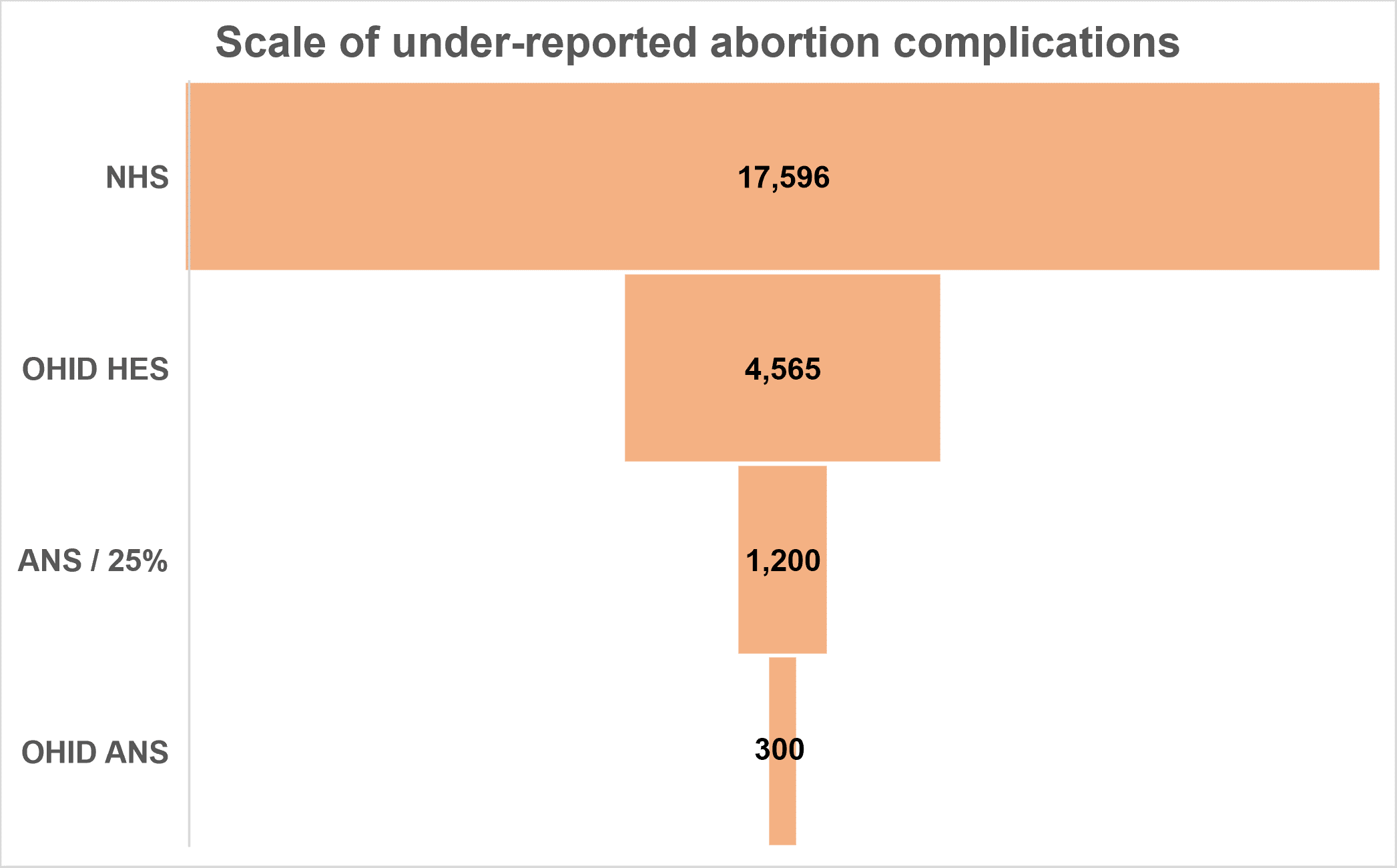
The OHID reports here just 300 complications; if we use the same rate and take account of the at-home abortions that have most likely been missed from this report, the number is 1,200. The previous report from the OHID, using HES data, stated an average rate of 18.2 complications per 1,000 abortions, and these are just those cases resulting in a hospital admission; this would mean a reported 4,565 abortion complications in 2022. The NHS states that “about 70 out of 1,000 women” will require treatment for an abortion complication, which suggests as many as 17,596 in 2022.
We should be calling on the OHID to stop misleading women and to ensure timely and complete reporting of all abortion complications – women deserve to be presented with truthful data and information when considering the possible outcomes from an abortion decision.
[i] Abortion statistics, England and Wales: 2022. (2024, May 23). GOV.UK. https://www.gov.uk/government/statistics/abortion-statistics-for-england-and-wales-2022/abortion-statistics-england-and-wales-2022
[ii] Complications from abortions in England: comparison of Abortion Notification System data and Hospital Episode Statistics 2017 to 2021. (2023, November 23). GOV.UK. https://www.gov.uk/government/statistics/complications-from-abortions-in-england-2017-to-2021/complications-from-abortions-in-england-comparison-of-abortion-notification-system-data-and-hospital-episode-statistics-2017-to-2021
[iii] NHS Website. (2024, March 11). Risks – Possible complications – Medical abortion. https://www.nhs.uk/conditions/abortion/risks/
Discover more from Percuity
Subscribe to get the latest posts sent to your email.
