In Northern Ireland, it has been shown that a law restricting abortion saved more than 100,000 lives in the years from 1967 to 2016. In June 2017, the UK government started to reimburse women who travelled from NI to access abortion services in England and Wales and then in March 2020, the government changed the abortion law in NI; these two changes have resulted in a threefold increase in the annual number of abortions in the six years to 2023/24 and a significant shift in NI’s societal behaviour towards abortion.
For more than 50 years, the law in Northern Ireland only permitted abortion if it was necessary to save the life of the pregnant woman. The 1967 Abortion Act in England and Wales, which is widely interpreted to permit abortion on request, was not extended to NI.
In 2017, Both Lives Matter published a study and conducted a marketing campaign in which it claimed that because NI had not embraced the permissive 1967 Abortion Act, more than 100,000 people were alive who would have had their lives ended in utero by abortion. Some people were upset by this claim and made official complaints. The Advertising Standards Authority (ASA) conducted its own analysis and, after consulting with expert healthcare statisticians, concluded that there is a reasonable probability that 100,000 individuals are alive today in Northern Ireland who would not be if NI had introduced the 1967 Act.[i]
During the years since the 1967 Act, some women travelled from Northern Ireland to England to access abortion services there; elective abortion services were not available in NI. In March 2020, Westminster enforced a new abortion law in Northern Ireland that is even more permissive than the 1967 Act. Initially the Department of Health in NI was slow to begin providing abortions, but early medical abortion is now easily accessible.
On 30 January 2025, the Department of Health published its latest set of ‘Northern Ireland Abortion Statistics’, for the year 2023/24. This table shows the numbers of abortions for each of the last ten years; these numbers include abortions provided to women in NI and those provided to NI residents accessing services in England and Wales (these data are only available up to 2022).
| Year beginning March… | Total abortions |
|---|---|
| 2014 | 853 |
| 2015 | 849 |
| 2016 | 737 |
| 2017 | 873 |
| 2018 | 1,061 |
| 2019 | 1,036 |
| 2020 | 1,945 |
| 2021 | 1,918 |
| 2022 | 2,340 |
| 2023 | 2,792 |
As can be seen, there has been a significant increase in the annual numbers in the years following the introduction of financial reimbursement in 2017 and the 2020 change in law; the number of abortions in 2023 are more than three times higher than those reported in 2017.
The Both Lives Matter analysis showed that the life-affirming impact of the prior law was saving on average 2,000 lives each year; we can now see that as a direct effect of the 2020 permissive law, that annual number of lives saved has been wiped out.

Annual abortion numbers in Northern Ireland reached a peak of about 1,850 in 1990, after which numbers fell year-on-year for 26 years. In June 2017, the UK government announced that it would start to fund abortions in England and Wales for women resident in NI. Prior to this, women from NI could access abortions in GB but were required to pay the abortion provider directly. This change in legislation resulted in a 22% increase in NI women travelling to GB for an abortion in 2018, as the DoH explained in its 2018/19 annual statistics report.[ii]
This graph very clearly shows the steep increase in the number of abortions in the three years following the implementation of the new, permissive, abortion law in March 2020.
In its 2017 ‘One Hundred Thousand’ report, Both Lives Matter says this about the impact of abortion law:
“Law has an important role in shaping perceived social norms, which are a powerful driver of attitudes and behaviours, within society. A strong signal is sent to society when laws are changed – in the case of the 1967 Abortion Act, the signal being sent is that abortion is “ok” and “normal” far beyond any medical reasons. As abortion becomes more ‘acceptable’, more women who might otherwise have rejected it as an option are willing to consider it.”
It is interesting, and perhaps somewhat sobering, to consider how the 2020 abortion law might now shape the social norms in Northern Ireland. Historically we find significant differences in the rate of abortions across the nations, indicating that there has been something different happening in NI.
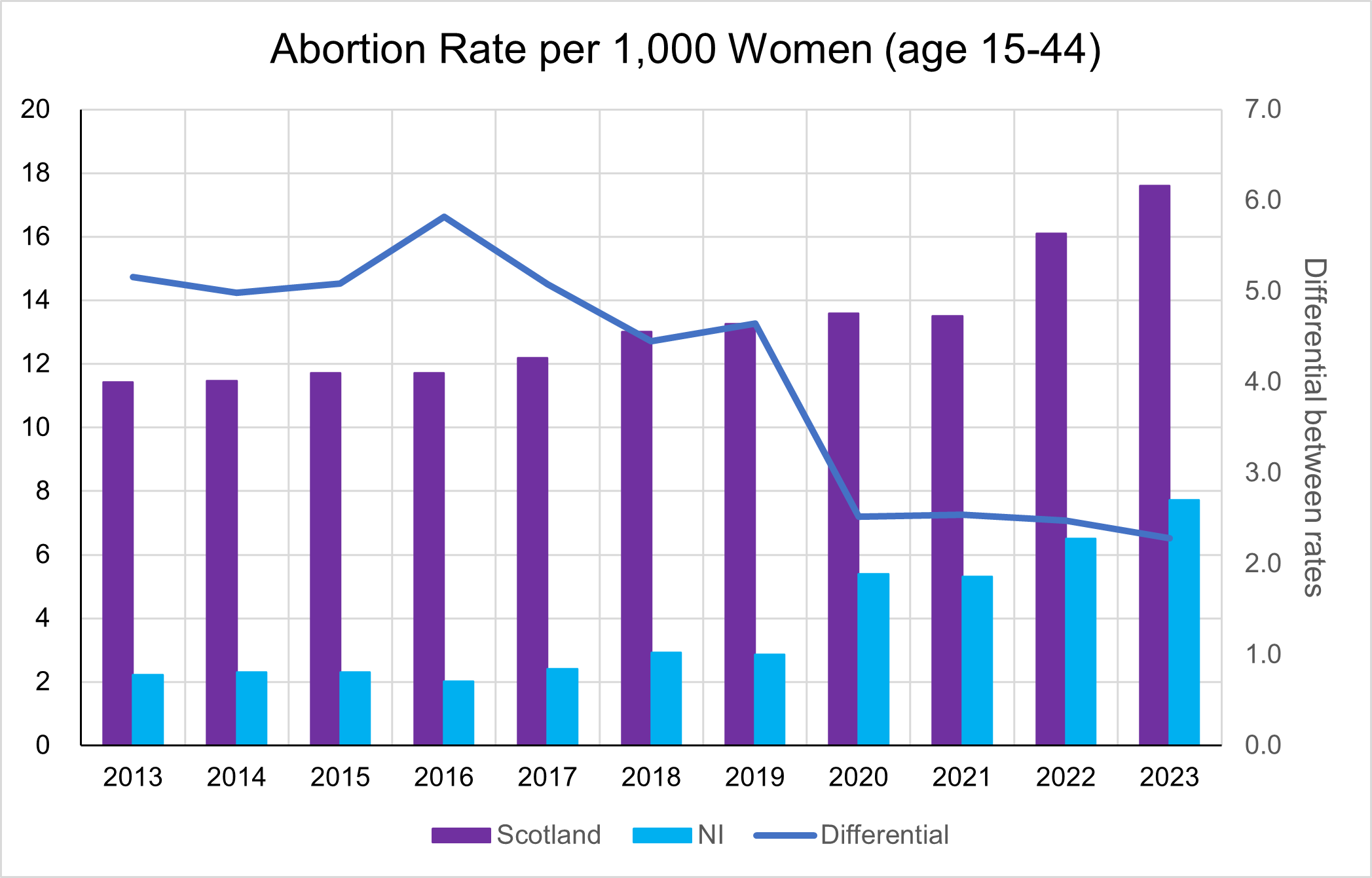
In 2013 the abortion rate per 1,000 women aged 15-44, was 2.2 in NI, less than one fifth of the rate of 11.4 in Scotland. Both Lives Matter and others have argued that culturally NI and Scotland are quite similar, and so this marked difference might indicate the impact of the abortion law in each country; up to 2020 NI’s being restrictive and Scotland’s being broadly permissive, similar to the one in England and Wales. We can see by 2023 this differential has more than halved; the rate in Scotland (17.6) is now just 2.3 times higher than the rate in NI (7.7), perhaps already showing the impact on societal behaviour of the permissive 2020 abortion law. It is also interesting to note on this graph the uptick in Scotland in 2022 that may be due to the increasing impact of abortion by telephone and pills-by-post, an abortion regulation that further normalises abortion, making it much easier to access.
Abortion activists in GB are lobbying for decriminalisation, to remove abortion from the criminal law and to make it available on request for any reason, with no limits. Ironically, they cite the 2020 NI law, saying that the rest of the UK now needs to catch up, that it is not right or proper for our sisters on the mainland to suffer restrictions that those in NI are now free from.
Do we really want abortion to be free from lawful restrictions and mandated standards of care; sending a message that it is of little consequence, leading to a growing societal acceptance that abortion as birth control is not just okay but that it’s normal?
We need better abortion laws; we don’t need or want these laws removed or to become so permissive that they lack any meaning or due influence. Abortion laws matter.
This post updates data previously obtained by Freedom of Information and used in this earlier post.
[i] Alliance, E. (2024, July 26). Statistics. Evangelical Alliance. https://www.eauk.org/what-we-do/initiatives/both-lives/statistics/statistics
[ii] Hillen, J., Mallon, S., & Hospital Information Branch. (2020). Northern Ireland Termination of Pregnancy Statistics, 2018/19 (pp. 1–6) [Report]. https://www.health-ni.gov.uk/sites/default/files/publications/health/hs-termination-of-pregnancy-stats-18-19.pdf
Discover more from Percuity
Subscribe to get the latest posts sent to your email.
