In August 2025, the Office for National Statistics published data showing the total fertility rate in England and Wales for 2024 was 1.41 children per women, the lowest value on record for the 3rd year in a row. There is little doubt that our birth rate is in decline—and so too are grandparents.
The data from the ONS tells us much more than just a projection of the average number of children per woman, and there are many different aspects to this. Let us consider e.g., how many young adults become grandparents.
Declining TFR will have a generation-by-generation impact with three possible outcomes:
- Adults who never have children
- Parents of children who never have children
- Parents of children who have children, i.e., grandparents.
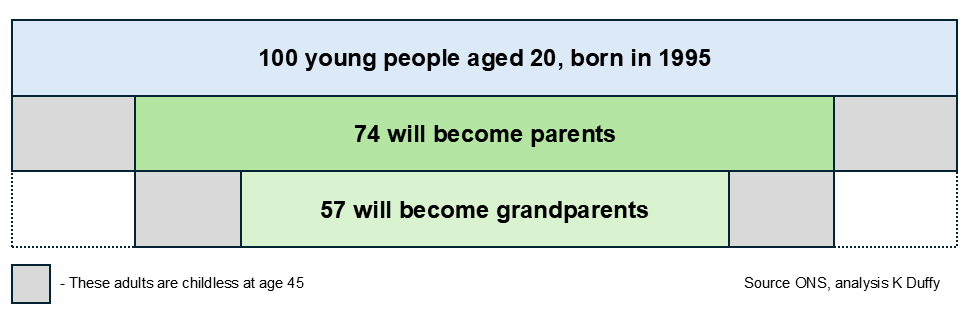
Analysing data for the most recent cohort of 100 young people aged 20, those born in 1995, we find the ONS projects that 74 of these will become parents, with an average of about 2.2 children per couple; 26 of their cohort will remain childless by age 45.
Of this second generation, 57 will have children of their own, whilst 30% of their cohort have none.
So, for each group of 100 young people today, only 57 of them will become grandparents, with an average of just over two children and about 4 grandchildren. 17 will become parents but have no grandchildren and 26 will have no children of their own.
Concerns are being raised about our declining fertility and there are a growing number of those calling on the government to consider policy changes to halt and reverse this. Rather than focusing on trying to encourage the 25% or more who might never have children, it might be easier to find ways to nudge a proportion of those who have children, to have one more. In the above cohorts, if just 25% choose to have one more child, we will see a reversal in the decline and a recovery of about 28% in our overall TFR, rising from the projected 1.4 to 1.8 in two generations.
Discover more from Percuity
Subscribe to get the latest posts sent to your email.

[like] Mark Pickering reacted to your message:
LikeLike