"With most abortions in England and Wales now performed by women at home, pro-life advocate Kevin Duffy fears for the health and wellbeing of the estimated 25 a day who suffer failed abortions."
Post-Dobbs: Use of online abortion pills increasing.

Research published by abortion activists indicates that women in the USA are making more than 6,000 requests each month for online abortion pills to be self-administered at home. This is an increase of more than 3,900 per month since the Dobbs ruling. Researchers Aiken, Starling et al measured the number of online requests for abortion... Continue Reading →
Abortion numbers nine-months after Dobbs.

In the US, in the nine months following Dobbs, there have been 81,000 less abortions in those States that have enacted life-affirming laws limiting access to abortion; that’s about 9,000 less per month. Of course, many women have been able to travel to access abortion in other States where these laws are not in force,... Continue Reading →
Florida Heartbeat Protection Act.
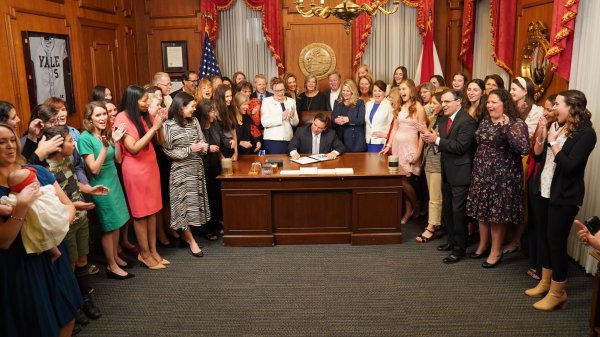
On 13 April, in Florida, Gov. Ron DeSantis approved and signed the Heartbeat Protection Act (SB 300) saying: “We are proud to support life and family in the state of Florida.” This legislation effectively bans most abortions after six weeks gestational age. However, it will not come into effect until after the decision by the... Continue Reading →
Abortion totals in USA drop by 32,000 in six months.
A new report in the USA shows how the Dobbs decision last year, led to 32,000 less abortions in the following six months. Average monthly abortion totals have fallen by about 6% and are now back to the levels reported in 2020, reversing a multi-year increasing trend. #WeCount is a national abortion reporting effort that... Continue Reading →
This is ideology not evidence.
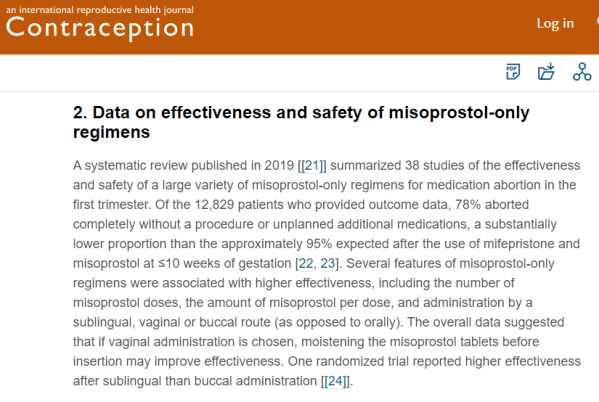
“…misoprostol, can be safely and effectively used on its own.” That’s what MSI Reproductive Choices is telling the public about a medical abortion treatment known to fail once in every five cases. This statement follows a similar one by Dr Grossman, a leading abortion researcher and advocate in the U.S., “What do people need to... Continue Reading →
The Abortion Pill is not always effective.

Medical Abortion (MA), aka the abortion pill, doesn’t always work; it is well-established that MA has an expected and commonly occurring treatment failure rate of about 5%. Meaning that as many as 1-in-20 pregnant women using abortion pills will subsequently need additional medical treatment for complications arising from an incomplete abortion. Medical abortion treatment failure... Continue Reading →
BPAS’s Annual Report 2021/22.
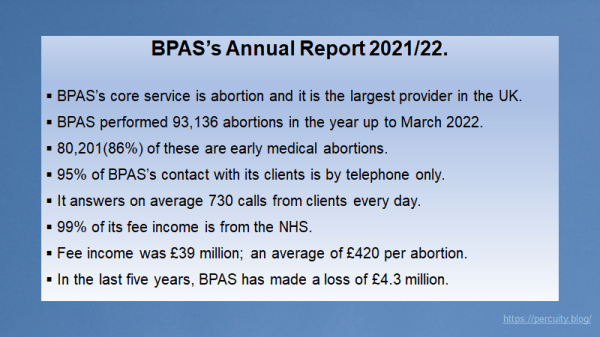
In 2021/22, the twelve months ending March 2022, BPAS performed 93,136 abortions, an increase of 18% over the total in 2017/18, a period in which the total number of abortions in England and Wales increased by 11%. BPAS continues to expand its share of the UK abortion market, providing about 43% of the total in... Continue Reading →
25,000 Reasons Why 95% is Not Good Enough.

New York Times review Research shows that the abortion pill fails in 5% of cases – that’s the findings from a New York Times review of 101 studies covering 124,000 first trimester abortions performed in 26 countries over the last 30 years. Non-negligible risk of failure. It is well-known that medical abortion will sometimes fail,... Continue Reading →
Are Abortion Pills Safe? Here’s the Evidence.

It's not just about ‘safety’ – the abortion pill (mifepristone and misoprostol) is medically safe for the woman; serious complications from medical abortion including hospitalisation, blood transfusion, major surgery, or death are rare. Arguing for changes to the legal and regulatory control of medical abortion solely based on safety is a very weak argument. Now... Continue Reading →

Abortions at home data in tab T2 of this file at https://www.gov.uk/government/statistics/abortion-statistics-for-england-and-wales-2021

"In the product literature the frequency of side-effects is generally described as above." This is from the British National Formulary at NICE.
Emergency Ambulance Responses Three Times Higher for Pills-by-Post.

Data obtained from five NHS Ambulance Trusts in England, show that emergency ambulance responses for complications arising after a medical abortion are three times higher for women using pills-by-post at home, compared to those who have their medical abortion in a clinic. Using our rights under the Freedom of Information Act, we asked each of... Continue Reading →
Shocking Fall in Service Standards at BPAS.

BPAS has reported that its abortion services are “under considerable pressure” and that the number of calls it has been receiving increased by about a third in the six months March to September this year. During the same period our volunteers were making mystery client calls to BPAS and MSI Reproductive Choices, and we found... Continue Reading →
Less Than 1-in-5 Complications are Reported.

Did you know that the Government and Abortion Providers routinely under report the rate of complications caused by abortion pills? Our freedom of information investigation reveals that less than 1-in-5 complications are being reported. DHSC Under Report. The official DHSC statistics for 2020 show a 1.1% complication rate for all medical abortions and only 0.3%... Continue Reading →
Medical Abortion Fails 1-in-17 Women.

Medical abortion doesn't always work; it is well established that MA has an expected treatment failure rate of about 6%. Which means that as many as 1-in-17 pregnant women using abortion pills will subsequently need hospital treatment for complications arising from an incomplete abortion. Ranbaxy (UK) Limited is the manufacturer of Medabon, the mifepristone/misoprostol combination... Continue Reading →
Fall in Annual Births is due to Abortion.

Data published by the Office of National Statistics, show clearly that the increasing gap between conceptions and births is due to the increasing number of abortions. The ONS notes: "Prior to 1969, the first full year for which abortions data were available, the number of conceptions was equivalent to the number of births." Source: Office... Continue Reading →
We consider the possibility that the mere experience of pain, without the capacity for self reflection, is morally significant. We believe that fetal pain does not have to be equivalent to a mature adult human experience to matter morally, and so fetal pain might be considered as part of a humane approach to abortion. Derbyshire... Continue Reading →
Reconsidering Fetal Pain.
Complications Related to Induced Abortion in Sweden.
A total of 4.1% of all medical abortions done at less than 12 weeks gestational age were incomplete and required surgical care in the form of a vacuum curettage procedure. Carlsson, I., Breding, K. & Larsson, PG. Complications related to induced abortion: a combined retrospective and longitudinal follow-up study. BMC Women's Health 18, 158 (2018). https://doi.org/10.1186/s12905-018-0645-6
Six Percent Require Emergency Care.

Gynuity Health Projects, a pro-abortion activist organisation, recently published results from its own study into the safety and efficacy of telemedicine abortion. Two key findings are: Six percent of women using abortion pills at home, subsequently needed hospital treatment because of complications related to the abortion, a rate of 1-in-17. Four percent of women using... Continue Reading →
