Heidi Stewart, chief executive of the British Pregnancy Advisory Service (BPAS), is urging Parliament to update abortion law to allow women to self-administer medical abortions at home throughout the entire first trimester—raising the current legal limit from 9 weeks and 6 days to 11 weeks and 6 days. She cites a recent study from Scotland, published in BMJ Sexual & Reproductive Health.[i] Yet a notable irony remains: Stewart is advocating for women to perform at-home a procedure that BPAS itself does not offer within its own clinical settings.
The study compared outcomes for 371 women (a very small study), with gestational age between 10+0 and 11+6 weeks, having an early medical abortion in Scotland during the five years up to March 2025, 258 at-home and 113 in hospital. The primary outcome measured was the rate of complete abortions, those not requiring any surgical intervention.
It is important to note that women self-administering the abortion pills at home, were provided with three additional doses of misoprostol and instructed to use these at 4-hourly intervals until the ‘products of conception’ were passed. There is only one reason to provide these extra doses, as stated in the study: “to increase the success of the abortion.” The study does not record how many women used any or all of these extra doses, but we should bear in mind that this could extend the period of cramping and contractions by up to 12 hours; one might have thought that in the interests of being patient-centred and caring about the impact of the abortion on women, Quinn et al would have measured and reported this critical aspect.
Notwithstanding the provision of these three extra doses of misoprostol, 3% of the at-home group subsequently needed a surgical procedure to complete the abortion and manage any resulting complications. This procedure, an evacuation of retained products of conception (ERPC), is one of three methods used in the management of an incomplete abortion, the other two being expectant management (wait and see), and additional doses of misoprostol, which, as the study indicates, some women will have managed that by themselves.
The study reports that 7% of the at-home group had an unscheduled return to hospital or the abortion facility, the authors note that this rate is of statistical significance when compared to the much lower rate for those who had their abortion in hospital.
I suggest that the first question an MP should ask Stewart when she starts campaigning for this, is ‘Why does BPAS not provide medical abortion at its clinics once the gestational age is more than 9+6 weeks?” I expect the reasons will include the many extra hours it takes for the medical abortion to complete at these later gestations, perhaps much longer than a normal working day at that BPAS facility, and/or the need to have a surgical team available to intervene when the medication fails.
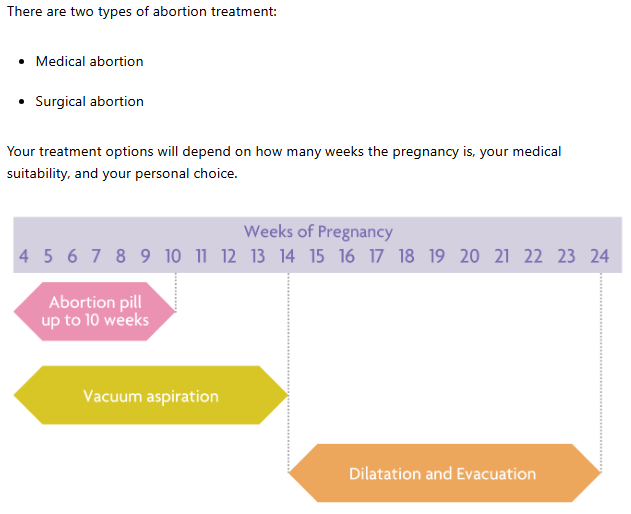
(https://www.bpas.org/abortion-care/abortion-treatments/)
[i] Quinn, J., Reynolds-Wright, J. J., McCabe, K., & Cameron, S. T. (2025). Safety and efficacy of early medical abortion at home between 10+0 and 11+6 weeks’ gestation: a retrospective review. BMJ Sexual & Reproductive Health. https://doi.org/10.1136/bmjsrh-2025-202947
Discover more from Percuity
Subscribe to get the latest posts sent to your email.
