Baroness Gerada was right, the figures from RCOG do not say that 1-in-17 women end up having complications from a medical termination, the number it states is actually more than twice that, 13% — 1-in-8 — nothing like one in 17.
On 02 February 2026, the House of Lords met as a Committee to discuss proposed Clause 191 of the Crime and Policing Bill — Removal of women from the criminal law related to abortion. During this debate, Baroness Gerada said:
“I think that I heard—I may have misheard—that one in 17 women end up having complications from having had a medical termination. That is not the figures from the Royal College of Obstetricians and Gynaecologists. It says that, under 10 weeks, one in 1,000 women have heavy bleeds and at, over 20 weeks, four in 1,000 do. Those women are in hospital. Clearly it is very different. It is nothing like one in 17.” [i]
Baroness Gerada is quoting from a table in a guidance document published by the Royal College of Obstetricians and Gynaecologists, entitled “Making Abortion Safe – Medical abortion from 12 weeks of pregnancy: Summary sheet”. You can access this document below.
The table, shown at section ‘3. Efficacy & Safety’, lists a number of risks related to medical abortion from 12 weeks gestational age. She quoted two of the most serious, and rare, risks, namely severe bleeding requiring transfusion. Just above this in the same table, she might have read out the line that directly relates to the 1-in-17 rate — which is the overall rate derived from NHS hospital statistics for cases of women admitted for treatment of complications from medical abortions at all gestations. I have explored this matter fully in earlier posts, e.g., 54,000 admissions to NHSE hospitals for abortion complications
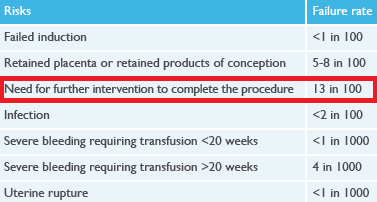
The RCOG states that the risk of needing further intervention to complete the procedure (medical abortion from 12 weeks GA) is 13 in 100, 13%, more than twice the 1-in-17, 5.8%, rate that she is contesting.[ii]
The women who would be ‘protected’ by Clause 191 are those who self-manage their medical abortion at home from 10 weeks gestational age. It is worth noting that RCOG, which is one of those campaigning most loudly for abortion decriminalisation, is doing so knowing that as many as 13% of these procedures will be incomplete, requiring further intervention. For women self-managing at home, that further intervention would require an admission for treatment at her local NHS hospital. I have noted before that in each of the investigation cases reported by campaigners in support of Clause 191, the women were first contacted by the police after the woman called for an ambulance or presented with complications at her local A&E.
This RCOG summary sheet provides further guidance to abortion providers for cases after 20w GA, regarding the need for lower doses of misoprostol and prior use of feticide to avoid the fetus being born with signs of life. Women for whom the RCOG is campaigning, will not be aware of this guidance and will not be able to follow it, and so their abortion is, using RCOG’s own terminology, not safe. You can read more about this in this earlier post: RCOG guidance for later abortions
[i] Crime and Policing Bill – Hansard – UK Parliament. (2026, February 2). https://hansard.parliament.uk/Lords/2026-02-02/debates/B847A0CA-90DA-43EC-BB08-F8038ADE364E/CrimeAndPolicingBill#contribution-845C4FE2-152E-4DA1-AC2B-54BF9FB52210
[ii] The cases requiring further intervention after 12 weeks, the 13% that RCOG states, are a subset of all such complications from medical abortions at all gestational ages. NHS hospitals record admissions for the treatment of these in the Hospital Episode Statistics. The complication rate varies by GA, it is lower for lower GA and rises steeply in cases of later gestation. The majority of medical abortions are carried out at GA less than 10 weeks, with complication rates of 5-6%.
Discover more from Percuity
Subscribe to get the latest posts sent to your email.

Leave a comment