On 02 February, whilst speaking in defence of Clause 191 which will decriminalise abortion for women, Baroness Sugg confirmed: “There have been 54,000 complications to medical abortion over the past five years…” [i]
This is the estimated total number of women admitted to an NHS hospital for treatment of complications arising from a medical abortion in the five years up to 31 March 2025, taken from the Hospital Episode Statistics (HES), as reported in this post last October, 54,000 admissions to NHSE hospitals for abortion complications.
It is worth noting that this is the total for inpatient cases, women admitted for treatment at an NHS hospital in England, there may be other cases in hospitals in Wales or in which women with complications were treated as an outpatient or using additional misoprostol at home.
Rates and prior years
Baroness Sugg, whilst acknowledging the year-on-year increase in the number of complications, rightly suggests that we should also consider the annual complications rate to make allowance for the increasing annual numbers of abortions. This table shows all of the relevant data from 2017 to 2023.[ii] [iii]
| 2017 | 2018 | 2019 | 2020 | 2021 | 2022 | 2023 | |
| Total medical abortions | 126,676 | 142,158 | 152,076 | 178,301 | 186,976 | 217,258 | 242,205 |
| HES complications | 9,200 | 9,800 | 10,100 | 9,000 | 9,700 | 10,900 | 12,000 |
| HES complications rate | 7.3% | 6.9% | 6.6% | 5.0% | 5.2% | 5.0% | 5.0% |
| ANS complications | 224 | 253 | 241 | 188 | 196 | 181 | 220 |
| ANS complications rate | 0.18% | 0.18% | 0.16% | 0.11% | 0.10% | 0.08% | 0.09% |
| Gap in ANS reporting | 8,976 | 9,547 | 9,859 | 8,812 | 9,504 | 10,719 | 11,780 |
| 95% | 95% | 95% | 96% | 96% | 97% | 96% |
Gap in ANS reporting
As is clear in the table above there is a very significant gap in the number of complications reported by the Department of Health and Social Care (DHSC) based on data received from abortion providers using the Abortion Notification System (ANS). Perhaps now that Baroness Sugg has gone on the record in stating the totals from the Hospital Episode Statistics (HES), this might add further weight to Lord Moylan’s push for official annual reporting to take data from both the ANS and HES.[iv]
2023 gestational age and complication rates
In 2023, there were 242,205 medical abortions and 12,000 cases reported in HES for admissions to treat complications from these medical abortions.
The DHSC reports the gestational age of these medical abortions as:
- 2 to 12 weeks 237,900 (98.7%)
- 12 weeks and over 3,200 (1.3%) [v]
The Royal College of Obstetricians and Gynaecologists (RCOG) has an e-learning module for abortion providers called ‘Making abortion safe’. In the related ‘Medical abortion from 12 weeks of pregnancy: Summary sheet’, it states: “The medical abortion treatment is not always effective, there is a 13% risk of the abortion being incomplete, requiring further intervention to complete the procedure.” You can read more about this guidance in our earlier post, RCOG guidance for later abortions.
Using the RCOG stated rate and the DHSC reported number of abortions from 12 weeks we find that of the 12,000 complication cases reported in HES, about 410 were for cases in which the gestational age was 12 weeks or more. Therefore the overwhelming majority of these complications cases, 11,590 (96.6%), were women admitted for treatment with complications arising after a medical abortion when the gestational age was less than 12 weeks.
Most medical abortions are now at home
There has been a huge shift in where and how medical abortions are administered. Before 2019, all medical abortions had to be administered by a clinician in an approved abortion facility. In 2023, 94% of all medical abortions were administered at home by the woman; in part (misoprostol at home after mifepristone in the clinic) or in full (both medications at home). DHSC reports a total of 228,570 at-home medical abortions (27,820 taking only misoprostol at home and 200,750 taking both).
- In 2018, there were 142,158 medical abortions, 71% of all abortions, and all of these were fully managed by clinicians in an abortion facility.
- In 2023, there were 242,205 medical abortions, 87% of all abortions, and almost all of these, 94%, were managed by women at home.
These data when combined with those from HES, show that every day an average of 30 women who self-managed their medical abortion at home, are subsequently admitted to an NHS hospital for treatment of related complications.
Rates have been reducing
Baroness Sugg makes the point that the complications rate has fallen in recent years:
“But rather than looking just at the total figures, when you look at the rates shown by the latest abortion statistics and the hospital episode statistics, the rate of complications for medical abortion has fallen by 25% since telemedicine was introduced.”
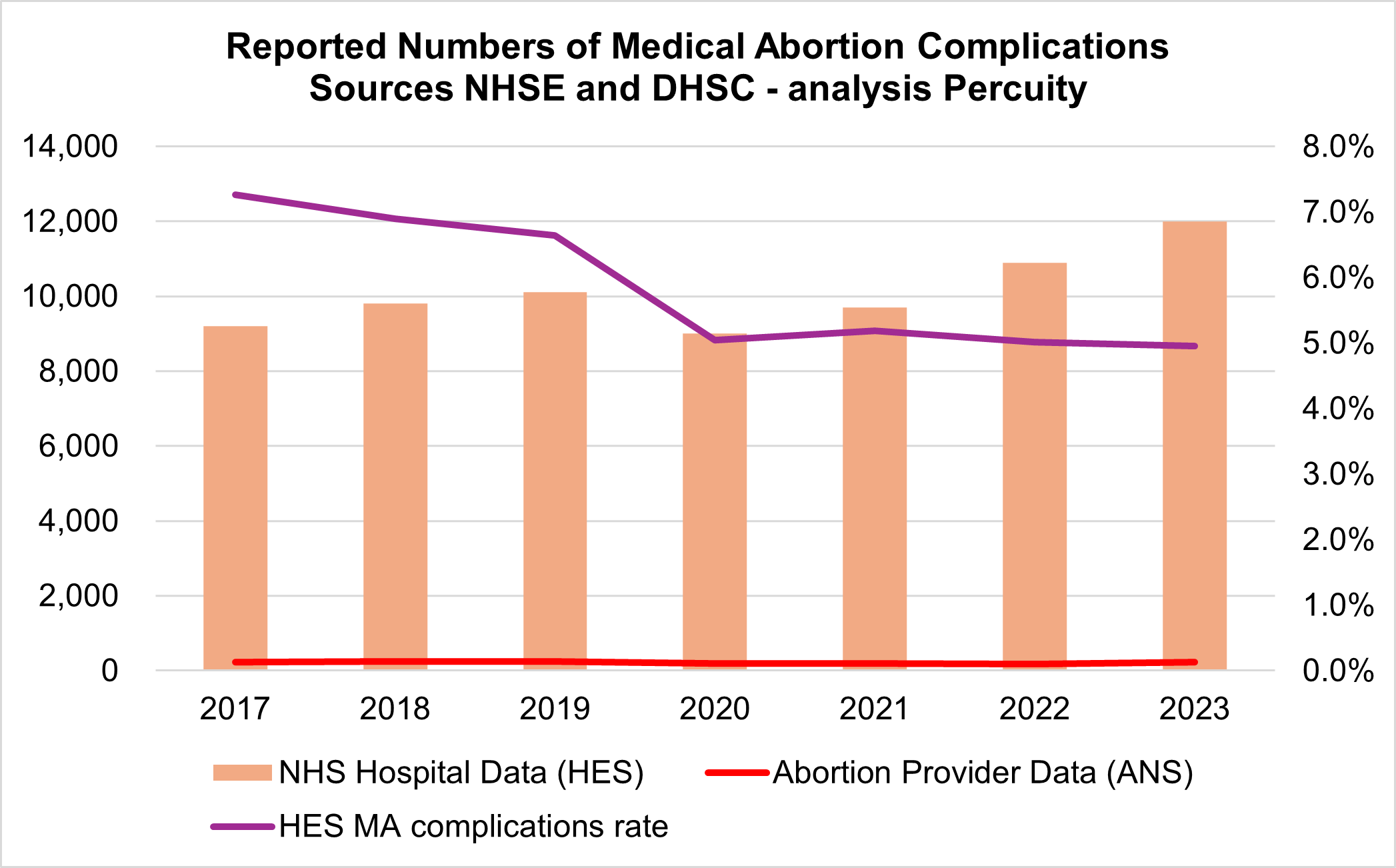
That is a fair point, the annual rate of medical abortion complications, as reported by HES, has fallen, from 6.9% in 2018 to 5% in 2023. However, I think Baroness Sugg is wrong when she suggests that this 25% drop is the result of more women being able to access early medical abortion at lower gestational ages.
In 2018, 94% of all medical abortions were GA up to 9w, by 2023 this had risen to 97%. I’m not so sure that this 3% increase is sufficient to drive a 25% reduction in the complications rate — something else has to be driving this.
Reasons for the reducing rate
By far, the biggest change from 2018 to 2023 is the huge proportion of these early medical abortions now being managed by women at home — up from none (0%) in 2018 to 94% in 2023. Given that change, here are two suggestions for the fall in the reported rate of complications.
Some of the 30% increase in the number of abortions in the period from 2020 to 2023 might be explained by including a count of prescribed pills-by-post that women are requesting but not actually using. The possibility of counting prescriptions rather than at-home abortions was raised in a recent article published by the Academy of Ideas.[vi] This may be happening in some cases but probably not in as many as the inferred 50,000 in 2023. Clearly, if the abortion pills are not used, there will not be any complications to be treated and reported by the NHS, and the overall total of medical abortions used as the denominator would need to be reduced.
Women are now self-referring for treatment at the NHS hospitals, whereas in 2018 they most likely would have been referred or admitted directly by their abortion provider. Some of these women might decide not to declare their use of abortion pills, suggesting instead to the hospital medical team that they are experiencing a natural miscarriage, in which case any treatments would be coded differently in HES and not be part of the 12,000 total.
In summary
Baroness Sugg has accepted the 54,000 estimate and a complications rate in 2023 of 5% — meaning that each day 30 women who have been managing their medical abortion at home, will be admitted to an NHS hospital for treatment of related complications. The data officially reported by the DHSC using the Abortion Notification System is woefully inadequate and the government, which says that it cares about the quality of women’s healthcare, must now change its annual reporting to include complications data from the Hospital Episode Statistics.
[i] Crime and Policing Bill – Hansard – UK Parliament. (2026, February 2). https://hansard.parliament.uk/Lords/2026-02-02/debates/08BD8B6A-D7FA-4A47-9655-008DCFB0C3CE/CrimeAndPolicingBill#contribution-057A325B-8566-4010-B7A4-7264C8CA8FA3
[ii] HES data are published by NHS England for each twelve month period from 01 April to 31 March the following year. We estimate a calendar year by taking 25% of the previous period and 75% of the current, so for the stated HES total in 2023, the calculation used was (2022/23 * 25%) + (2023/24 * 75%).
[iii] Abortion totals and ANS complications are for England and Wales, sourced from the annual abortion statistics published by the Department of Health and Social Care.
[iv] Duffy, K. (2025, October 20). 54,000 admissions to NHSE hospitals for abortion complications. Percuity. https://percuity.blog/2025/10/02/54000-admissions-to-nhse-hospitals-for-abortion-complications/
[v] Note that, as explained in note 1 in the DHSC published spreadsheets, some numbers and percentages are rounded down and so there are slight variances in totals from one table to another and percentages may not always add up to 100.
[vi] Lee, E., & Whelan, E. (2026, February 1). Abortion: understanding new approaches to women’s freedom. Academy of Ideas. https://www.academyofideas.uk/p/abortion-understanding-new-approaches
Discover more from Percuity
Subscribe to get the latest posts sent to your email.

[heart] Mark Pickering reacted to your message: ________________________________
LikeLike